Showing posts with label Side Projects. Show all posts

July 30, 2023

Design Feast’s Side Projects Series—117th Interview: Product Designer Ken Pan Collaborated on a UX Design Job Board to Help Applicants Save Time


What are you working on—on the side?

We, Gracia (Junzhu) Zhang—Product Designer & Visual Designer, Kyle (Chentao) Wang—Product Manager & Front-End Engineer, and myself, are Ciwei, a name that comes from the Chinese word for “hedgehog.” The hedgehog was our choice, because socialized on Chinese internet, hardworking folks are often lovingly referred to as “Kings of Rolling Up” or “卷王”—much like how hedgehogs curl up into a ball. We wanted to embody this spirit of hard work but in a cuter way, hence: Ciwei.

Our journey began with a group of UX graduates—all of us working tirelessly to land jobs in a highly competitive market. Realized we were spending a lot of time each day looking at new job postings, filtering out those that matched our qualifications and finally applying. This was a time-consuming process, and we knew there had to be a more efficient way. That’s when the idea for Ciwei was born—to help everyone find suitable job opportunities quickly—leaving more time for self-improvement and networking.

(My other side project is creating a UX New Graduate Community—consisting of 500+ members from almost every major design school in the US. That’s the “a group of UX graduates” I mentioned earlier.)

Here’s what we do at Ciwei: our community members, who are also job seekers, contribute by adding job openings they find during their search to our platform. Behind the scenes, we categorize and analyze these job listings. With the help of OpenAI’s engine, we highlight important information that our users care about. For example, if you’re a fresh graduate, you might be overwhelmed by the vast amount of unrelated job recommendations on platforms like LinkedIn. We filter through the noise for you, picking out jobs with lower experience requirements so that you can focus on opportunities that really suit you.

This is already something pretty helpful to our job-hunting journey. But we’re not stopping here. We’re currently looking into features like helping you auto track of jobs you’ve applied, and even providing insights into your interview success rate. More than just a job search tool, we want Ciwei to be a supportive community for UX graduates.

How do you manage to work on your side project(s)?

The driving force behind Ciwei, first and foremost, is my passion for community organization and helping others. The struggles of job hunting, something I’ve continuously observed in our UX new grad community over the past year, made me desire 


Thank you for your curiosity! Continue reading this interview at Design Feast on Patreon.

Help Design Feast to keep producing this kind of content! Lots of hours are put into making Design Feast—because it’s a labor of love to champion creative culture through hundreds of interviews, dozens of write-ups and more. Consider becoming a supporting Patron with a monthly donation—all that’s asked is $1 or another tier that feels good to you.

What will stay free to completely explore at Design Feast are the 347 insightful interviews with an awesome range of Designers, Bloggers, Makers and realizers of Side Projects.

July 19, 2023

Design Feast’s Side Projects Series—116th Interview: AI Product Designer Steven Phung Equips Extensively the UI & UX Design Community with UX Gears

What are you working on—on the side?

I am the humble creator behind UX Gears, a vast design repository that seeks to inspire UX, UI and product designers across the globe. Within UX Gears, you’ll discover a delightful collection of over 500 handpicked links—carefully curated with love. From an abundance of UI, UX tools to ingenious AI-powered design tools, captivating illustrations, charming typography, delightful iconography, invaluable accessibility guides, comprehensive design systems and a never-ending wellspring of inspiration, UX Gears is here to support your creative journey.

Throughout my own seven-year design expedition, I’ve witnessed firsthand the remarkable impact UX design has on organisations and their products. It is like a hidden gem, a humble gear that quietly drives startups, fuels the growth of scale-ups, and empowers enterprises to reach new heights. Its significance may not always be apparent, but make no mistake—it plays a pivotal role in maintaining order and propelling the entire engine forward.

That’s precisely why I created UX Gears, a comprehensive repository of design resources that will help not just junior designers to accelerate their career in very competitive industry but also provide meaningful aid for pro-designers to create impactful digital experiences.

With UX Gears, my aim extends far beyond a mere repository. It is a friendly haven, a space where designers of all skill levels can find solace, inspiration and the tools they need to thrive in a fiercely competitive industry.

How do you manage to work on your side project(s)?

Managing UX Gears, alongside my full-time job, goes beyond traditional time management. It’s about balancing my passion, commitment and adaptability. There are some techniques and strategies to manage my workload


Thank you for your curiosity! Continue reading this interview at Design Feast on Patreon.

Help Design Feast to keep producing this kind of content! Lots of hours are put into making Design Feast—because it’s a labor of love to champion creative culture through hundreds of interviews, dozens of write-ups and more. Consider becoming a supporting Patron with a monthly donation—all that’s asked is $1 or another tier that feels good to you.

What will stay free to completely explore at Design Feast are the 347 insightful interviews with an awesome range of Designers, Bloggers, Makers and realizers of Side Projects.

August 15, 2021

Typeface Designer Chantra Malee Pays it Forward through the Malee Scholarship for Empowering Women of Color as They Pursue a Career in Type Design


What are you working on—on the side?

The Malee Scholarship is a not-for-profit organization that I started with Sharp Type, a boutique NYC type foundry that I co-founded with my business partner and husband, Lucas Sharp. Each year, the Malee Scholarship grants a $6,000 USD scholarship to a woman from an underrepresented ethnic group in the type industry, who is passionate about type design. Our goal is to empower these women, give them a platform to show their work, and through our mentorship program, teach them the ins-and-outs of designing type and running a foundry.

In addition to selecting and awarding an annual scholar, we also recognize 3 finalists who were top contenders for the scholarship that year and also announce a small selection of Women of Typographic Excellence who demonstrated incredible skill in type design. 

How do you manage to work on your side project(s)?

It takes a village! The development of the organization was challenging and incredibly fun. Throughout the process, we made sure to work with individuals whose work we greatly admired. We first commissioned Tien-Min Liao to develop the logomark, which Sharp Type designer My-Lan Thuong later evolved into a sans and serif type system, which we use as the primary typefaces for the brand. What The Studio came in later and developed our branding, and designed our website, later developed by Default Value.

Our team at Sharp Type all contribute, and I’m so grateful for their participation and hard work. Florence Fu and My-Lan Thuong have been integral to the running of our institution, and Lucas Sharp plays a big role in the mentorship program, meeting with the recipients weekly to critique their work. Together with Connor Davenport, Calvin Kwok and Justin Sloane, we’re able to pull it off.

Why have a side project?

I am from the United States of Thai, Spanish and Native American descent. I, myself, was a recipient of the Urban League’s Student Scholarship Program, which provides financial assistance to students from minority groups who are pursuing higher education. From a financial aspect, the grant was huge for me, but even more profound was being seen, and recognized by their institution. I’ll never forget their generosity. Now that I’m in the position to do so, I am paying it forward.

What I wasn’t prepared for when starting The Malee Scholarship was how much I would learn from the experience and the applicants whom we’ve met since we began. They’ve opened my eyes to global cultures and social issues around the world that I wasn’t quite familiar with. Many of our applicants have not only a passion in type design but in social justice issues as well. It’s awe-inspiring to read their stories. They encourage me to be better and I’m very thankful for them, and can’t wait to see them reach great success in type.

• • •

Diptych courtesy of Chantra Malee.


❤️ Donating = Appreciating: Design Feast is on Patreon!
Lots of hours are put into making Design Feast—because it’s a labor of love to provide creative culture to everyone. If you find delight and motivation from the hundreds of interviews, including event write-ups, at Design Feast, please consider becoming a supporting Patron with a recurring monthly donation.

Help keep Design Feast going and growing by visiting my Patreon page where you can watch a short intro video plus view my goals and reward tiers—starting at $1 per month. Starting your patronage today matters—it’ll help Design Feast continue to be an exceptional service, integral to the creative community.

August 7, 2021

Freelance Designer Daniela Covarrubias Adores and Advocates Plants for the Home


What are you working on—on the side?

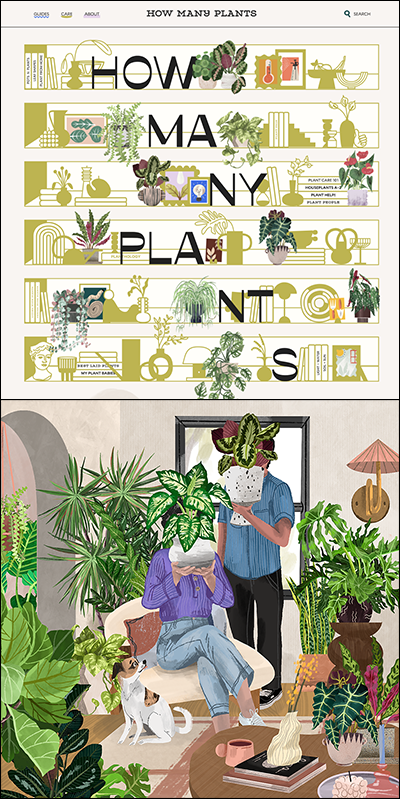
“How Many Plants” is a plant-care resource for anyone interested in houseplants, whether you’re a seasoned enthusiast or just getting started. I found a lot of the plant-care information online to be all over the place and often contradictory, so I wanted to build a robust resource that would be fun to engage with and genuinely useful!

I mean, why waste time googling in circles and opening tab after tab only to be more confused than when you started? For this reason, I was intent on creating a “go-to” resource that would not only fully elaborate on the care of specific plants, but also dive deep into larger topics like propagation and dealing with pests. And as a bonus, I wanted to position the whole thing through the lens of design and interiors since that’s my field of expertise. For me, greenery is an essential part of any designer’s toolkit—equal to any piece of furniture or paint color. Plants have the power to transform a space from something pretty good to something downright magical. Often, they’re the missing piece that will make a space come to life … literally! I’m continuously amazed by what a versatile design element plants can be. They can play the role of sculpture, anchoring a space or filling an empty corner. They can bring in heaps of color and texture, playing off other patterns in the space or standing out against solids.

And while I clearly love how plants look in real life, I wanted to take a fresh approach for this project. I found that a lot of plant photography can make plants look somewhat unattainable in either their lushness or setting. Or they are photographed with retail/shipping in mind which usually means they are young, fresh out of the greenhouse and it can be hard to envision their growth. I believed a bit of abstraction would go a long way to inspire and get people excited to imagine plants in their own space. So I was super-lucky to connect with a wonderful illustrator, Evie May Adams, who was willing to dive into this big project with me and take on everything from the illustrations of the plants themselves, along with icons, interiors and tons of one-off vignettes and diagrams for the long-form articles. Truly, the site wouldn’t be what it is without the illustrations.

How do you manage to work on your side project(s)?

To be honest, I was quickly overwhelmed by the scope of the project. What I thought would take 5 or 6 months to get off the ground, ended up taking closer to 9 months. I just had such a specific (and ambitious) vision in my head of what I wanted “HMP” to be, and I was a bit stubborn about the need for it to be fully realized before putting it out into the world. I don’t necessarily think this is the best approach to a side project, but for me, it worked to keep the momentum going strong upfront so the project could then take a bit of a backseat going forward. Also, having something fully baked gave me a more complete picture of how my audience was experiencing the site, which helps me understand what people are liking or missing before building out any additional features.

It’s still a fairly new thing for me, so I can’t say for sure, but it’s my hope that the project will continue to take on a natural rhythm of lulls with more intense activity. Especially as a freelancer, this would nicely mirror how work tends to flow in my day-to-day!

Why have a side project?

While I’m passionate about the topic of plant care, this project was ultimately a way for me to learn a bunch of new skills. I’m trained as an architect and have been working in interiors for the past 6 years, so I had super-minimal web experience before creating this site. I had to learn everything from how to design around breakpoints to how to structure content for CMS and everything in-between.

I was originally inspired to create “How Many Plants” both by circumstance and by my husband, Moe. The circumstance was the pandemic, and Moe happens to be a skilled web developer that has been pursuing side projects since we met in grad school (his career was born out of a side project!). Moe and a bunch of his friends had recently started using a tool called Webflow to quickly build websites without code. And witnessing that work gave me the confidence that I could make something myself. It was also quite exciting to be able to take full creative control of a project—there was no design director, no client, no budget, no external deadline driving my decisions. This freedom was such a huge contrast to what I had experienced in architecture and interior projects. In some ways, it was daunting, but mostly it was just so satisfying. And it created an unexpected feedback loop to my day job that reinvigorated my design thinking and helped me reevaluate my approach to limitations.

• • •

Diptych courtesy of Daniela Covarrubias.


❤️ Donating = Appreciating: Design Feast is on Patreon!
Lots of hours are put into making Design Feast—because it’s a labor of love to provide creative culture to everyone. If you find delight and motivation from the hundreds of interviews, including event write-ups, at Design Feast, please consider becoming a supporting Patron with a recurring monthly donation.

Help keep Design Feast going and growing by visiting my Patreon page where you can watch a short intro video plus view my goals and reward tiers—starting at $1 per month. Starting your patronage today matters—it’ll help Design Feast continue to be an exceptional service, integral to the creative community.

June 6, 2021

Type Crit Crew Founder, Juan Villanueva, Harnesses the Appreciation, Education and Diversity of Typography


What are you working on—on the side?

In April of last year, I founded Type Crit Crew, which is a free resource for type design students to meet 1–1 with experienced type designers for virtual critiques. Our goals are:
  • To make type design and type designers more accessible and approachable to students of all levels from anywhere in the world who are serious about honing their skills
  • To do our part in making our field more inclusive and diverse
  • To spread our love and passion for type
This initiative started during the pandemic at a time when education was making a huge shift online. As someone who is deeply interested in education and aware of the obstacles that exist to get into the field of typeface design, I saw an opportunity to make education more accessible, to connect people and to make a positive contribution to my field. Type Crit Crew is a very simple idea, it’s basically a spreadsheet, and its power comes from the community. Its existence is a statement that the type design community wants to be more accessible, inclusive and supportive of up-and-coming talent from all over the world. This is something I wish I had access to while I was studying type. I’ve been able to connect with so many students from all over the world through Type Crit Crew. I’m really grateful to the students that use the platform to reach out and to the instructors that continue to volunteer their time.
 
Another side project is the Display Type BIPOC Fund which is a fund that offers scholarships for BIPOC students to attend my Display Type Design class at Type@Cooper. I started this fund when I began teaching at Type@Cooper, where I’m an alum. I’m very grateful for the experience and the education I received there. My teachers and mentors had a huge impact on the way I teach and work as a designer.
 
I started teaching type design in the summer of 2020, during a global pandemic and daily protests fighting for racial justice. I did it not only because I wanted to share my knowledge in type with others but also because I saw an opportunity to do things differently. As a BIPOC type designer teaching type, I want to see more type designers of color and change the landscape of the field by giving BIPOC designers a seat in my class. But that’s only part of it. Through my syllabus, I want to reframe what an education in type design can be by bringing in the human component of the practice and showing how the skills can be useful and empower people to express themselves. Shameless plug → Check out our class website at displaytypedesign.com
 
The last side project I started at the end of April of 2021 was Typefaces as Cultural Objects which is a collection of typefaces by Latin American Designers that honor and preserve Latin American culture and heritage. As a person from Latin America living in NYC, there is almost no Latin American representation in design education, and even less so in type design education. Through this side project, I want to make visible the work that Latin American designers have been doing in the area of type design, so that students today have more diverse references and designers to look up to and engage in conversation with. I’m starting with 11 projects and have a few more to add to the list and the goal is to make a resource that others can contribute to and use.
 
All of my side projects are part of and inspired by the larger group effort from the global community. Because of this I want to highlight initiatives like BIPOC Design History, Letrástica Communidad, Times New Woman, TypasType, TypeThursday (Bogota, Barcelona, Mexico, New York and others), the Alphabettes Mentorship Program, and my friend Lynne Yun’s own Type Design School BIPOC scholarship, to name a few.

How do you manage to work on your side project(s)?

Before I launch any project, I’m very conscious of the time-commitment these things might take and, in theory, I strategically plan for them to be not so high maintenance. In practice, I put in hours mainly on the weekends but sometimes during the week in the evenings as well.
 
Even though the team at Monotype, where I work full-time as a type designer, is remote and the hours are somewhat flexible, I try to have a clear division between my job and my personal side projects. This is really important, since apart from my side projects, I also teach and volunteer on the board of the Society of Scribes.

Why have a side project?

For me, it’s a way to give back to the creative community that I’m a part of. Ultimately, all of my projects are the types of initiatives I would’ve liked to see when I was a student, or the types of things I want to see happening now. They’re about highlighting other creatives, uplifting designers, opening doors and hopefully creating a more inclusive, collaborative future. I’m an introvert, but I know that making oneself visible and being vocal can help others feel seen and perhaps inspire them to follow their own paths.

• • •

Diptych courtesy of Juan Villanueva.


❤️ Donating = Appreciating: Design Feast is on Patreon!
Lots of hours are put into making Design Feast—because it’s a labor of love to provide creative culture to everyone. If you find delight and motivation from the hundreds of interviews, including event write-ups, at Design Feast, please consider becoming a supporting Patron with a recurring monthly donation.

Help keep Design Feast going and growing by visiting my Patreon page where you can watch a short intro video plus view my goals and reward tiers—starting at $1 per month. Starting your patronage today matters—it’ll help Design Feast continue to be an exceptional service, integral to the creative community.

May 23, 2021

Christina Li is Forging the Current-to-Future Advancement of Mentorship and Leadership in UX Design and Research


What are you working on—on the side?

I have two side projects. They are uxmentor.me and Leading Research.

I co-founded uxmentor.me with my friend, Chris Mears, over 8 years ago in 2013. It’s a User Experience (UX) mentoring program. Our aim is to help designers and researchers to transition into the UX industry and support them in their first UX jobs.

It has evolved over the years and we now offer 1:1 mentoring services (with a monthly subscription).

Over our 8 years of experience, the biggest gap we see is the transition period to your first UX jobs. You might have taken a UX course, but the support and resources drop off when you finish. This is where uxmentor.me comes in. We developed a tailored mentoring canvas. This is unique to each of our mentee so we can  chart progresses together.

My second side project is Leading Research which I started with Swetha Sethu-Jones. We started this initiative out of necessity.

In 2019, there was a get-together for the ResearchOps community in London. In the get-together, half of us were towards the top end of the career ladder in user research. And we were asking ourselves questions, like: How do we progress further? Some of us are practitioners who don’t want to be a leader, but then your practitioner role runs out at senior level. As a leader, we also asked: Why is research always under design discipline, could it be a separate branch? Can user research discipline get a seat at the table as Chief Design Officer? Or Chief Research Officer?

For this community is about providing support and networking for leaders. It’s a chance for us to forge a path for the user research discipline. What does the future of user research look like? There are still a lot of unknowns; research as a specialism is grey but we haven’t had time to define it. So, this is an exciting opportunity to answer some of those sticky questions!

Our first meetup was in January 2020, in a small group discussion format to discuss impact. We deliberately wanted an intimate setting. We wanted everyone to be comfortable in sharing their successes and lessons. Our plan for 2021 is to continue to run small events online and curate relevant content for the community.

How do you manage to work on your side project(s)?

Be super-organised, use suitable tools and delegate where needed.

My approach to time management has changed over the years. The main lesson is that if my time is a pie, how big would the ‘side projects’ wedge be? I am a lot more focused and stopped procrastinating once I know how much time I can commit to it.

We have a model that works well for us now for uxmentor.me, it is a lot easier to manage my time on that. I know what I need to commit to to provide a good mentoring experience for my mentees. With Leading Research, it’s still a young community we do have to put a lot more time into it. There are some intense periods of engagement as we plan for events or curate content for the blog, followed by quiet periods. So I guess it all balances out at the end!

Trello is a great planning tool. For example, in each of my side projects we use four columns: backlog (ideas we have and want to do), to do (the next things we have to do), doing and done.

Don’t be afraid to ask for help! Learning when you need help and ask for it is a healthy thing.

Why have a side project?

To me, it’s about giving back to the communities I am part of. With mentoring, it is like holding up a mirror to yourself and asking how you are performing. But it also makes you think on your feet and I quite like that.

As you accumulate knowledge and experience, you may think that some things are so obvious. But, they aren’t simple to others and that becomes useful to someone else. It's also a nice challenge to think about how you communicate complex ideas in a simple way. We want people to digest the information easily!

• • •

Diptych courtesy of Christina Li.


❤️ Donating = Appreciating: Design Feast is on Patreon!
Lots of hours are put into making Design Feast—because it’s a labor of love to provide creative culture to everyone. If you find delight and motivation from the hundreds of interviews, including event write-ups, at Design Feast, please consider becoming a supporting Patron with a recurring monthly donation.

Help keep Design Feast going and growing by visiting my Patreon page where you can watch a short intro video plus view my goals and reward tiers—starting at $1 per month. Starting your patronage today matters—it’ll help Design Feast continue to be an exceptional service, integral to the creative community.

May 16, 2021

From her book “Chasing Portraits” to the platform ”Authors Answer,” Author and Documentary Film Producer Elizabeth Rynecki Seizes Passion in Passion Projects


What are you working on—on the side?

I’m kind of a side project addict. You originally asked me about Authors Answer, so I’ll start there.

During the March 2020 pandemic shut-down in California, I realized that many authors might not be able to get out into the world to promote their books. Getting your book into the hands of just the right reader is hard enough without further obstacles like a worldwide pandemic. I’m a fan of author interviews, but had grown weary of formulaic classics like “What books are on your nightstand?” or “What book inspired you to be a writer?” and even “You’re having a dinner party … which three authors (dead or alive) do you invite?” I thought it would be fun to give authors a platform to wax eloquently about the influences on their writing lives off the written page. I wrote a list of 20 questions and decided participants should answer FIVE. The project is now a year old. Over 200 authors have participated, including: novelists, memoirists, academics, poets and picture book authors. I hope authors continue to submit answers because while they get to promote their backstories. I learn about so many new-to-me authors and their books.

For more than a decade, my bigger side project has been “Chasing Portraits.” A book and documentary film, the project is about my quest to find the art of my Polish-Jewish great-grandfather, who perished in the Holocaust. Spanning three decades of my life, and three generations, it’s a narrative about the richness of one man’s art, the devastation of war, and my family’s unexpected path to healing. The book came out from Penguin Random House in 2016. The film premiered in 2018. I continue to do virtual book club events and film Q&A events.

My personal pandemic side project is a multimedia journal. In a spiral bound, 9” x 12” sketchbook, I document life. Sometimes I write about the day’s events or make black-out poetry. Other times I draw. Occasionally I paste things onto the pages. Mostly it’s just for me, although sometimes I share pieces of it on my Instagram account. I’ve now hit the one-year anniversary mark and while I thought about stopping, my family encouraged me to keep going. It’s interesting to flip back and remember some of the crazy, scary and stressful things that happened to our family, community and the world over the last 12 months. Maybe in a few generations, someone might be interested in what I recorded.

How do you manage to work on your side project(s)?

I am fortunate enough to have a great deal of flexibility in my schedule. I’m also exceedingly grateful to have a family that supports and encourages all my part-time creative ambitions. The house is a mess, the dishes don’t always get done, and the laundry piles up, but no one seems to care too much.

Why have a side project?

They bring me joy … mostly! Creativity is HARD WORK. I stumbled a lot in my own projects. I wish I had a new Authors Answer blog post every day, my drawings aren’t great (a well-meaning friend called them childlike … which they are), writing does not come easily to me, I get frustrated and jealous of other people’s awe-inspiring work, and frequently feel like a failure. [By the way, a lot of creative people have Imposter Syndrome.] But you can’t wait to do a project until you’re an expert, because they only way you get better at the tough things is to KEEP DOING THEM. As Eleanor Roosevelt once said, “You gain strength, courage and confidence by every experience in which you really stop to look fear in the face. You are able to say to yourself, ‘I have lived through this horror. I can take the next thing that comes along.’ You must do the thing you think you cannot do.” Plus, life without passion projects just isn’t life enough for me.

• • •

Diptych courtesy of Elizabeth Rynecki.


❤️ Donating = Appreciating: Design Feast is on Patreon!
Lots of hours are put into making Design Feast—because it’s a labor of love to provide creative culture to everyone. If you find delight and motivation from the hundreds of interviews, including event write-ups, at Design Feast, please consider becoming a supporting Patron with a recurring monthly donation.

Help keep Design Feast going and growing by visiting my Patreon page where you can watch a short intro video plus view my goals and reward tiers—starting at $1 per month. Starting your patronage today matters—it’ll help Design Feast continue to be an exceptional service, integral to the creative community.

May 10, 2021

Product Manager Adam Attas Co-Founded an Organization Excited by Compelling Ways to Greatly Intertwingle Design and Business—Starting in Chicago, Illinois


What are you working on—on the side?

I’m the co-founder of Business Designers | Chicago which is focused on the intersection of design and business—how this intersection creates meaningful, sustainable and mindful value. Our members have diverse backgrounds in design and business. They seek to create richer conversations. We foster this desire through guest and member presentations, social events, working sessions, published content and more. Our mission is to use business design methods and mindsets to influence change and drive impact through hybrid thinking, including the formation of meaningful alliances between practitioners, educators, entrepreneurs and innovators—in order to improve the world we all live in. It’s a lofty goal—but worthy cause. 

We’ve been doing happy hours, speaker series, workshops and more since November 2018. I started the group with Leon Hovanesian, a Business Strategy Manager at Doblin, because we realized that there is more than one way to be successful as a “business designer.” My journey from my formal education to my career in product management may look different from Leon’s journey on paper, but what we realized through our initial conversations way back was how similar our perspectives on innovation and systems thinking were. We were also super-passionate about tracking all of the changes in the industry and how they were impacting our peers and those graduating from places like the Institute of Design, Kellogg plus other schools teaching business design. 

I started this group because I hate formal networking, but I love talking about hybrid thinking. I don’t want people to come to our events because they are seeking a job or trying to level up their LinkedIn profile. I want people to form meaningful connections and I want our content to speak to people who think these things matter.

One of the first exercises we ever did as a group was to get people together to talk about whether they felt more aligned to a business discipline with design empathy or a design discipline with business empathy. We did this in a physical space where we could actually line ourselves up along that spectrum and have a conversation about why we placed ourselves where we did. These moments are really special because they showcase why we are different from your traditional meetup group. Creating the right environment to bring together people from business and design backgrounds of all types is really what this is all about.

Outside of Business Designer | Chicago, I spend a lot of time giving back to tennis. I worked with EPIC Chicago to do a brand refresh for the non-profit Tennis Opportunity Program (I’m the treasurer of the organization). I also worked with some people at the Intercollegiate Tennis Association to provide advisory support for Tennis for America, a post-graduate year of service for collegiate athletes to give back. 

I have some other side projects I’ve wanted to kick off but never really had the same momentum. At some point, I want to either start a venture studio, build a tennis club or start my own company. 

How do you manage to work on your side project(s)?

It’s all about having the right people around you to help manage your energy levels. It’s really easy to get super-excited about an idea and do a ton of work in a vacuum and then burn out quickly. I like to put an initial idea on paper and then socialize it a ton with friends, family members and people’s opinions who I really value. Some people may think it’s crucial to keep a novel idea a secret, but I actually think the opposite. So much of getting a good idea right is in the execution itself. I also think these conversations energize me just as much as the work itself. 

COVID has made it really hard for me to keep this up. My day job has been pretty all-consuming and with such little separation between the home office and the virtual office, I often don’t want to look at a screen outside of work hours. I’m looking forward to the coffee shop conversations, drinks and whiteboard sessions in the post-COVID world. 

Why have a side project?

A career is so much more than the things we do at work. Additionally, our jobs should not define us. I’ve always thought of myself as a builder and a connector, but at times during my career, I’ve felt like I couldn’t own the process of planting a seed of an idea and growing it into a living breathing organism. With a side project, you can do that at your own leisure on your own timeline. I find that type of autonomy refreshing. I also think of side projects as a way to test the waters without diving in headfirst. I can dabble in something new. I can put it down and pick it up when I want. Lastly, the people I’ve met through all of these experiences is what makes this worthwhile. Being intentional with my time and having things I’m truly passionate about are really important to me. 

• • •

Diptych courtesy of Adam Attas.


❤️ Donating = Appreciating: Design Feast is on Patreon!
Lots of hours are put into making Design Feast—because it’s a labor of love to provide creative culture to everyone. If you find delight and motivation from the hundreds of interviews, including event write-ups, at Design Feast, please consider becoming a supporting Patron with a recurring monthly donation.

Help keep Design Feast going and growing by visiting my Patreon page where you can watch a short intro video plus view my goals and reward tiers—starting at $1 per month. Starting your patronage today matters—it’ll help Design Feast continue to be an exceptional service, integral to the creative community.

February 28, 2021

At Literation, Michelle Ruiz Explores the Eclectic Range of Books that Inspire Designers and Creative Practitioners


What are you working on—on the side?

Literation is an Instagram and web project featuring designers, artists, and studios, who share some books, zines, published ephemera and so on which specifically inspire their creative practice. The books that my guests share are so varied. Some have unique, one-of-kind items, some just have one item they love, and some have familiar design favorites. For the ones that are somewhat widely available, a long-term project of mine is to make a directory or list with links to purchase. That’s an ongoing thing, but in the meantime, I try to have as many book titles linked or listed on the website.

How do you manage to work on your side project(s)?

This has been a big challenge. It’s weird, but on one hand, I’m lucky I don’t have a huge following so I don’t have the pressure to maintain a “brand” of any kind and post constant updates. That lack of pressure has been helpful during the pandemic. This project kind of just follows my own timeline and availability (and response time from guests). Last year, I have been more sporadic with my work on Literation, mainly because my mental capacity reached its max! I’m slowly picking up the pace again and have some good guests coming up.

A lot goes into it and each post involves managing the images I get sent, research and writing copy on the guests, looking up the books so I can link to the publishers, creating the drafts for Instagram and web, formatting photos, tagging, and so on. In the very beginning of the project, I was posting up to three times a week! Which tires me just thinking about it. So now, I try to make sure my enthusiasm for Literation maintains a healthy energy, even if that means not posting as frequently.

Why have a side project?

A few years ago while in between jobs, I was looking for ways to stay motivated and generally connected to inspiring ideas, projects, people, etc. For me, a huge part of that has always been through books. So I wanted an extension of that curiosity in a side project which would also help stay inspired myself. While I’m always interested in what people are generally reading, I was specifically fascinated by how books are used for research or inspiration in a design or art context. Now I have way too many books I’d personally love to check out!

• • •

Diptych courtesy of Michelle Ruiz, featuring books shared by brand experience design studio GRDN, Montreal, Quebec, Canada.


Donating = Appreciating: Design Feast is on Patreon!
Lots of hours are put into making Design Feast—because it’s a labor of love to provide creative culture to everyone. If you find delight and motivation from the hundreds of interviews, including event write-ups, at Design Feast, please consider becoming a supporting Patron with a recurring monthly donation.

Help keep Design Feast going and growing by visiting my Patreon page where you can watch a short intro video plus view my goals and reward tiers—starting at $1 per month.

April 19, 2020

Travel Writer Tim Brookes Studies, Carves and Advocates the Writing Systems of Indigenous and Minority Cultures through His Endangered Alphabets Project


What are you working on—on the side?

If something is important, we write it down.

Ten years ago, I discovered that most of the world’s writing systemsperhaps 90%—are in danger of extinction. No longer taught in schools, lacking official status, used by a small and dwindling number of elderly people, these writing systems nevertheless have served, in some cases for 2,000 years, as a primary means of expressing and recording the accumulated experience and wisdom of their cultures. Lose the alphabet, and within two generations not only is the information lost, but the sense of a shared past, a shared identity and purpose, is also lost.

I bought myself a set of hand tools and began to carve pieces of text (proverbs, spiritual texts, sometimes just individual letters) in some of these fascinating, often exquisite alphabets—and in the process discovered that many of them embody truths not only about their people and their culture but about writing itself. This became the Endangered Alphabets Project. In the past decade, I’ve done more than 150 carvings, exhibited them at colleges, universities, museums, libraries and galleries around the world, spoken about the vital importance of language and writing to cultural survival, and collaborated with individuals and groups who want to restore their language, their script, their identity, their sense of self-respect and self-determination. In addition to doing carvings, giving talks and promoting these scripts and their cultures, I’ve also published storybooks, teaching materials, journals, coloring books and illustrated dictionaries in minority scripts.

I’ve pulled together pretty much all I know and made it available to the public—in the online “Atlas of Endangered Alphabets.”

In the process, I’ve also become very much of a beginner calligrapher and typographer, though frankly most of my art/design work is based on the genius of indigenous people exploring their own endangered scripts, and of a small group xenotypographers who have given time, sweat and tears to create non-commercial versions of traditional scripts. I’ve also become a beginner woodworker/wood artist, and have come to respect the artistic properties of wood and the fact that not only is every kind of wood different, but every piece of wood is different. Working to combine the wood and the script to the best advantage of both is a challenge that never ends, and never fails to be fascinating.

How do you manage to work
on your side project(s)?


The Endangered Alphabets Project began as a side project while I was directing a college writing program. For the past 20 months, it has been my sole occupation, so that means I need to do a lot of fundraising, especially focusing on a Kickstarter campaign every year. Before this, I did my carving in the evenings and on weekends, and discovered how relaxing it is, paradoxically, to work with my hands last thing at night, so the act of focusing on that manual work drove out all the mental turmoil of the day, like a form of meditation.

Why have a side project?

I’m not sure I’ve ever worked harder or been happier. As I said, having a piece of wood in my hands every evening is the ideal end to a day. Beyond that, having a sense of purpose larger than my own head is a huge relief. The Endangered Alphabets have been very active on social media for the past 24 months or so, and it is an amazing thing to have a dozen or fifty people every day tell you you’re doing a good thing—I wish every person in the world could have such daily validation. And there is something astonishingly deep about making something beautiful. I don’t say I’m happy with all my work—I’m certainly not—but to be able to step back and see you’ve made a shape and a color and a line that works to your satisfaction…well, it goes a lot deeper than words. And that depth circles around to why writing systems are so closely connected to, and so deeply felt, by their communities, some of whom have embedded their writing symbols in flags or coins or banknotes or seals or tattoos or jewelry even though they themselves can no longer read them. That’s the paradox and the mystery I’m after.

• • •

Diptych courtesy of Tim Brookes.


Donating = Appreciating: Design Feast is on Patreon!
Lots of hours are put into making Design Feast—because it’s a labor of love to provide creative culture to everyone. If you find delight and motivation from the hundreds of interviews, including event write-ups, at Design Feast, please consider becoming a supporting Patron with a recurring monthly donation.

Help keep Design Feast going and growing by visiting my Patreon page where you can watch a short intro video plus view my goals and reward tiers—starting at $1 per month.

April 3, 2020

Copywriter Brooke Randel Co-Creates a Family Memoir with Golda Indig—Her Grandma and a Holocaust Survivor


What are you working on—on the side?

For the last few years, I’ve been co-writing a memoir with my grandma Golda Indig titled Also Here. My grandma is a Holocaust survivor who, after being held in three Nazi concentration camps, never spoke about it. Then one day, she started telling me I should write her story. It came out of nowhere for me. I was a copywriter at a small agency in Philly at the time, creating scripts and billboards, brochures about sausage casings, that sort of thing. I had no idea what I was getting myself into. When I finally agreed to sit down with her, I was blown away by how much I hadn’t known. The horrors she faced, the depth of her courage and pain, how raw it all still was—it stunned me. I started doing research to fill in the gaps in her story and came to learn even more. For the first time, I could trace my family’s history and see the ways in which it has shaped us, our habits, who we are and how we function. The legacy of trauma is something we as a culture have just started scraping the surface on. In Also Here, my grandma shares how she sprinted, hid and stole her way to survival while I tell the story of what happened next. We are looking for a publisher now.

When I’m not working on the book, I write fiction and creative non-fiction, and am a reader for the Chestnut Review. No matter how different the style or subject matter may be, it all influences my copywriting and vice versa.

How do you manage to work
on your side project(s)?

I wake up early and write before work. Sometimes, I’ll also write after work, at home on the weekends and occasionally on the bus between the two. The bus is an amazing place to reflect, observe and get ideas.

Part of the joy of writing for myself is that I have no deadlines or clients. So there’s no pressure to crank something out. I just write—and write and write and write until I have something worth re-writing.

Why have a side project?

Ironically, or perhaps hypocritically, I’ve actually written against the side project before. Too much celebration of it can make side projects feel like a mandatory for anyone in a creative field. There’s more to life than working, even creative work, and that includes sitting under trees, eating ice cream cones before they melt and teaching your nephew your favorite song.

But then, here I am, with a side project. Call it cognitive dissonance.

The reason I write outside of my copywriting work is because I enjoy it. Because I have extra creative energy to expend. Because I want to say something a little more complex than a four-word headline. Because, in the case of my memoir, my grandma kept asking me until I caved. For anyone debating whether or not to pick up a side project, I’d say don’t. Not unless it fills you more than it empties you, giving you something your regular creative work never could.

• • •

Diptych courtesy of Brooke Randel.


Donating = Appreciating: Design Feast is on Patreon!
Lots of hours are put into making Design Feast—because it’s a labor of love to provide creative culture to everyone. If you find delight and motivation from the hundreds of interviews, including event write-ups, at Design Feast, please consider becoming a supporting Patron with a recurring monthly donation.

Help keep Design Feast going and growing by visiting my Patreon page where you can watch a short intro video plus view my goals and reward tiers—starting at $1 per month.

January 27, 2020

Not Finding a Scottish Whisky Distilleries Map that Matched His Requirements, Designer Dale Watson Illustrated His Own


What are you working on—on the side?

My side projects are mostly illustrative. Over the past year, I’ve been working on multiple whisky-related projects, including simple illustrations of each Scottish distillery (an ongoing project) and detailed Whisky Maps of Scotland and Japan. The maps plot the location of each whisky distillery for a handy (and hopefully beautiful) reference guide.

I’ve also recently moved onto another subject I’m passionate about, nature, and am currently working on a series of bird illustrations inspired by my travels around the north of England, Scotland and New Zealand. It’s early days on this one at the moment. All of these works then populate my Instagram profile which I suppose is kind of another side project.

How do you manage to work on your side project(s)?

I’m often more excited about the side projects than my full-time work, so I manage to squeeze in little pockets of time whenever I can. It might be while I’m waiting for a brief to come in or for clients to give feedback, but it’s mostly just for an hour in the morning before the official working day starts.

My full-time work as an Art Director and Designer can swing from busy, fun and interesting to quiet, tedious and rather dull. It’s during the latter periods when it’s important to find pockets of time to think about my side projects—to keep me feeling creative and inspired.

It’s also a great opportunity to experiment, try new techniques and see what you can achieve to improve and grow. This will then, of course, also benefit my actual job too.

Why have a side project?

Mainly, it’s just for the fun of it—I’ve always enjoyed drawing for as long as I can remember. Illustrating and designing is a hobby, so it’s great that I get paid to do it too.

Sometimes, I start a side project when I have a want for something. This is how my Whisky Map of Scotland project started, I wanted a nice-looking reference map to sit alongside my whisky collection but just couldn’t find one anywhere which fit my brief. I wanted a map to include all currently working distilleries—most maps are out of date or just focus on the most popular ones. I also wanted it to plot major landmarks and towns so I could have an idea of roughly how close things were. In the end, I created it for myself.

Because I find illustration so enjoyable, it might one day become something that I’d like to focus on more, maybe even specialise in, and so, side projects are great for developing skills and also for building a potential future portfolio.

• • •

Diptych courtesy of Dale Watson.


Support Design Feast on Patreon!
Your readership means a lot. Lots of hours are put into making Design Feast—because it’s a labor of love to provide creative culture to everyone. If you find delight, even a level of motivation, from the hundreds of interviews, including event write-ups, at Design Feast, and are able to contribute, please consider becoming a Patron to support this long-term passion project with a recurring monthly donation.

Help keep Design Feast going and growing by visiting my Patreon page where you can watch a short intro video, view my goals and subscription-plus-reward tiers, from $1/month to $12/month—between a souvenir and a satisfying brunch. Every bit of support makes a difference in allowing me to generate all of this content on a regular basis. Thank you for your consideration!

October 29, 2019

Pride, Work and Necessity of Side Projects: Creative Mother-and-Son Time between Designer Joni Trythall and Ben


What are you working on—on the side?

I started Bologna and Ben a few years ago with my son. Ben took an interest in my work early on when he would catch me making things in Illustrator or planning animations on CodePen. One day, he got home from school as I was finishing up some icons and he began to replicate them on paper next to me at my desk.

I found the level of detail he picked up on incredible for a four-year old and it inspired me to start the project as a way to document these types of adventures. It was perfect timing since Ben loved drawing but couldn’t always think of an idea to put on paper. This provides him with a subject to focus on while he practices drawing and tries to match colors. I’ll show him some of my illustrations to choose from and we settle in at the kitchen or living room tables with snacks and music.

We do fewer posts these days because he has become much more creative than myself and simply doesn’t need the inspiration as much anymore. His friend recently had a birthday and Ben drew him a flying sausage because “his favorite color is red”; I could only dream about coming up with something so clever!

You can still find us at the table with muffins and mini-chocolate chips every once in a while on mom-and-Ben nights, and he gets new supplies each year on holidays. He most recently improved some design work I did for Soft Skills Engineering.


How do you manage to work on your side project(s)?

This is one of my favorite side projects since it has always been super casual with no pressure, for it to be more than it is; it’s whatever we want it to be and it doesn’t matter if anyone else follows along. We will sit down together whenever Ben has the urge to do some drawing, but this creative time together has evolved to take on other forms as well over the years. For instance, he helped me design a “favorite” icon animation for work a couple weeks ago, describing a series of beating, outlined hearts. I built a prototype and made additional changes as I was instructed until it was just right. He also helped describe the perfect easing for a loading animation and is the first to say “This is OK but I liked the other thing better,” which is a level of honesty that is invaluable and difficult to get from adults.

Why have a side project?

I’ve had countless side projects over the years as a way to embrace what I love doing without getting burned out by only doing it in the context of formal work. I get to set my own constraints and don’t have to overanalyze anything, it can just be a thing because I want it to be, and it brings me and others joy.

My favorite projects have been in relation to kids. I’ve taught workshops to middle schoolers about web design and CSS animations. Later this year, I’ll be heading to an elementary school to show them some animations while they design their own on paper, followed by a mini-workshop for the same middle school about hand-coding SVGs. Kids possess a breathtaking amount of creativity and pick up on complex things so quickly, it’s such a pleasure getting to show them a small glimpse into a career most of them are not aware of. There are few things that light up a kids face more than showing them how to move something across a screen.

Bologna and Ben specifically has been a way to bring Ben into my work in a stress-free and relatable way. He knows about branding and logos, he selects smart colors, he draws thoughtful things for people as gifts. I have worked from home since he was born, the lines between work and home life just don’t exist, but I try as much as possible to make sure this overlap is fun, educational and nurtures his innate curiosity. 

• • •

Diptych courtesy of Joni Trythall.


Donating = Appreciating: Design Feast is now on Patreon!
Lots of hours are put into making Design Feast—because it’s a labor of love to provide creative culture to everyone. If you find delight and motivation from the hundreds of interviews, including event write-ups, at Design Feast, please consider becoming a supporting Patron with a recurring monthly donation.

Help keep Design Feast going and growing by visiting my Patreon page where you can watch a short intro video plus view my goals and reward tiers, from $1 to $12—between a souvenir and a satisfying brunch.

October 14, 2019

Pride, Work and Necessity of Side Projects: Designers Miho Aishima and Kat Garner Founded Creative Space “Rye Here Rye Now” as a More Friendly, Less Formal, Gathering for the Creative Community


What are you working on—on the side?

We run Rye Here Rye Now, a creative platform based in Peckham Rye, London. We hold monthly meetups bringing together creatives from all areas of the industry. We’ve also run events with Tate Modern, the Great Get Together and Peckham Festival.

We started holding our monthly meetups two years ago because we felt that a lot of the design talks and events we were going to were quite formal and could be intimidating to people just starting out. We wanted to create a space where people can feel relaxed. We make sure to provide opportunities throughout our events for people to engage with each other and spark conversations.

Miho: When we started Rye Here Rye Now, I was freelancing and missed the kind of conversations that I would have at the pub with colleagues and other designers when I was in a studio full-time. We have met so many great people and have become a part of the creative community in Peckham in the last few years which has been wonderful.

My other side projects include: preparing for a group exhibition with some artists to open early next year and collaborating with a friend on an annual retreat for our group of inspiring women-designer friends.

Kat: One of the reasons I was excited to start Rye Here Rye Now was that working in a studio alongside a consistent team means there’s was less of an opportunity to meet new creatives, one of the best things about RHRN has been meeting and becoming friends with so many great people through these nights that we put on.

How do you manage to work on your side project(s)?

Kat: We meet up and plan for Rye Here Rye Now a couple of times before each event to chat through the plan for that month. Now that we’ve been running it for two years, we’re quite prepared in terms of what needs to be done and when things should be publicised or posted on social media and how to divide up that work, because we do both have full-time jobs to get this done around.

Miho: It can be very difficult, but I often dedicate time in the evenings after work and on the weekends. Sometimes, I even have to take calls about projects during my lunch hour, but I think it’s definitely worth it. I think you need to put in the hours to build something meaningful and worthwhile.

Why have a side project?

For us, Rye Here Rye Now was something that we felt was needed and we were excited to provide a platform, bring together a creative community and provide a chance for people to meet and collaborate.

Miho: I think side projects give you the opportunity to explore ideas that may not fit into your day-to-day work. You can also try something without committing to it as a full-time job; however, it does mean you have to be a bit more organised with your time.

Being a creative can be tough especially in a city that is so big, expensive and competitive like London. By creating Rye Here Rye Now, I feel that we are building a supportive place for all creatives to feel welcome and share their stories. That makes this side project worthwhile for me.

Kat: Generally speaking, I think it’s important to have side projects to exercise your brain and your creativity in different ways. Finding something that you can be passionate about, that is driven just by your interest in it, can make you feel more excited about the client-facing design work you do. However, I think too often people take on side projects because they feel like it’s a requirement, and feel obligated to constantly be posting work. There’s no benefit to burning yourself out for the sake of looking busy, especially if it’s not adding anything to your life or your practice. I’d say choose your side projects carefully—don’t feel like it needs to be something you have to show anyone or monetise if you don’t want to, and that way, it will be so much more rewarding.

• • •

Diptych courtesy of Miho Aishima and Kat Garner—their joint portrait photographed by Matthew Pull.


Donating = Appreciating: Design Feast is now on Patreon!
Lots of hours are put into making Design Feast—because it’s a labor of love to provide creative culture to everyone. If you find delight and motivation from the hundreds of interviews, including event write-ups, at Design Feast, please consider becoming a supporting Patron with a recurring monthly donation.

Help keep Design Feast going and growing by visiting my Patreon page where you can watch a short intro video plus view my goals and reward tiers, from $1 to $12—between a souvenir and a satisfying brunch.

October 7, 2019

Pride, Work and Necessity of Side Projects: Emily J. Smith’s Itch to Keep Writing Naturally Sparked the Founding of Matchmaking App Chorus—Her Tech Startup


What are you working on—on the side?

My main side project is my writing. I write essays, mostly, and I’m also working on a novel and a nonfiction book. I started writing about five years ago. I never studied it, or did it professionally; a career in the arts had always felt out of the question, financially. I studied engineering and then went to business school. My world was always numbers, not words.

I started writing on the side in my thirties. At first, I was afraid to admit that I wrote in my free time. I thought it would seem absurd or worse—cute—that I felt my thoughts were interesting enough to take the time to write down. So I did it in secret initially. But eventually, I started to publish a few pieces and, over time, it got easier to admit. Now I call myself a “writer,” but when I hear other people say it, it still feels strange.

My other side project, which has since turned into my full-time project, is my company, Chorus. Chorus is a matchmaking app where friends swipe for friends (please sign up!). A lot of my writing has to do with relationships, dating and technology, and so I think about the dynamics of connection constantly. I had been shopping the idea for Chorus to friends for over a year and getting great feedback, and one day I just decided to go for it. I put together a business plan and a pitch deck, and found an amazing (all-female) team passionate about the idea. This summer we secured our first round of funding so now we’re full speed ahead!

How do you manage to work on your side project(s)?

When I first started writing, I spent all my free time doing it. I did it before and after work and on weekends. That sounds depressing, I know, but I had never given myself that kind of time and space to just sit in my own thoughts. The notion of writing had always felt too self indulgent or self-important. I hate to characterize it this way, but, to me, back then, the self-obsession required to create art felt masculine. But once I started, it was all I wanted to do. I was so used to thinking in response to others, to having others opinions and reactions influence my thoughts and feelings, and to just have the space of the page to untangle my ideas was addicting.

Now I can’t live without it. I get an itch to write if I don’t for a while. Like if your sink fills up with dishes—it happens, but at some point, you have to clear it out. If I don’t write, my thoughts clutter up in my head and I need to work through them to feel at ease.

Writing is kind of my side project again now that I’m working full-time on Chorus, so I try and clear my weekends to work on my book projects. Luckily, the two are closely related. I have to write a lot about relationships in service of Chorus. It’s a nice balance in many ways. I like having both creative and analytical projects to switch back and forth on. When I get stuck on a Word document, there’s always a spreadsheet to jump into.

Why have a side project?

I think it’s absurd that we assume we can or should only be one thing in life—like if we’ve worked as x, then we can’t one day be y. I think a lot of people, as they get older, are afraid to try new things even if they’re dying to do it, because it’s uncomfortable to be terrible at something and also serious about it. But the only way to start anything is to be bad at it at first. We develop an ego as we get older, like we should know what we’re doing with our lives. But even the most practical among us never really do, so far better to just admit it. Side projects are a great way to pursue an interest that we may not be good at, but that we actually enjoy.

The other thing is that side projects can lead to real projects. My side project of writing led, in many ways, to getting funding for my startup. After writing about the problems with dating, I built up a credibility on the topic. It’s strange, because at first, writing about dating and relationships felt like a liability with regards to my career, it was embarrassing to publish such honest material. But then I saw how people connected with that kind of honesty—even people I worked with.

Everything we do adds to our experiences in some way, we just have to keep following our interests. No matter how bad and embarrassing it may feel at first.

• • •

Diptych courtesy of Emily Smith—her portrait photographed by Mae Ryan.


Donating = Appreciating: Design Feast is now on Patreon!
Lots of hours are put into making Design Feast—because it’s a labor of love to provide creative culture to everyone. If you find delight and motivation from the hundreds of interviews, including event write-ups, at Design Feast, please consider becoming a supporting Patron with a recurring monthly donation.

Please help keep Design Feast going and growing by visiting my Patreon page where you can watch a short intro video plus view my goals and reward tiers, from $1 to $12—between a souvenir and a satisfying brunch.

June 17, 2019

Pride, Work and Necessity of Side Projects: Freelance Graphic Designer Jess Lewis Took the “36 Days of Type” Challenge


What are you working on—on the side?

36 Days of Type, a personal project to animate all 36 letters and numbers of the alphabet with cities across the world. 36 Days of Type is a project organised by designers from Barcelona that invites designers, illustrators and graphic artists to express their particular interpretation of the letters and numbers of the alphabet. Participants are challenged to design a letter or number for each day, showing the ability to represent the same symbols simultaneously and from thousands of different perspectives. I decided to take part to try and force myself to experiment more with animation and push myself outside of my comfort zone. I didn’t end up finishing the whole series, due to work commitments, but managed to complete all the letters.

How do you manage to work on your side project(s)?

I originally started designing one animation per day. I quickly realised that if I wanted to finish the series, I’d need to get more organised, and so, started doing a couple per day so I could schedule them. Unfortunately, other work began to build up and I eventually ran out of time.

Why have a side project?

Being a creative freelancer, I always feel that I should focus on client work over personal projects, so it was nice to spend time doing something different and having some time for myself. I don’t often get a chance to spend a big chunk of time enhancing my skills and it was really beneficial setting myself a personal daily design challenge.

• • •

Portrait and animation courtesy of Jess Lewis.


Donating = Appreciating: Design Feast is now on Patreon!
Lots of hours are put into making Design Feast—because it’s a labor of love to provide creative culture to everyone. If you find delight and motivation from the hundreds of interviews, including event write-ups, at Design Feast, please consider becoming a supporting Patron with a recurring monthly donation.

Please help keep Design Feast going and growing by visiting my Patreon page where you can watch a short intro video plus view my goals and reward tiers, from $1 to $12—between a souvenir and a satisfying brunch.