March 27, 2011

Thank You from Daily Grape’s Gary Vaynerchuk

Being thankful means not taking anyone or anything for granted. Anyone or anything can lead to someone or something worthwhile. Like all practices of virtue, it’s easier said than done. One demonstration of thanks came from wine and social media force Gary Vaynerchuk of Daily Grape.


Review copies with winning cover design by Owen Song, Kneadle, Inc.

He posted a contest for designing the front cover of his latest book, “The Thank You Economy”. Vaynerchuk’s get-up-and-move takes on his vlog about personal branding, in addition to his snooty-free gonzo coverage (1,000+ videos to date) of wine, are highly recommended. When he announced a design contest for the front cover of “The Thank You Economy”, his follow-up to “Crush It!: Why NOW Is the Time to Cash In on Your Passion” (also a Bestseller on “The New York Times” List), it was taken as a legitimate opportunity to get published.


While none of my three concepts were picked, one was selected for inclusion in the book (above). A month after submitting my concepts, I was asked for my permission for publication. The message stated, “Gary wants to take care of everyone who took part in this.” This act of being thankful could have been overlooked. But Vaynerchuk made it necessary. I’m reminded of my Parents’ regular push to give thanks—as well as all their other teachings, which I keep being thankful for and keep relearning.

Here’s a big thanks to Gary V. for emphasizing the importance of expressing thanks and keeping it.

• • •

Listen to an Audio Review of Gary Vaynerchuk’s Book “Crush It!”, about Passion and Personal Branding

March 17, 2011

Keeping Design Just Enough: Mari Sheibley, Foursquare’s First Designer


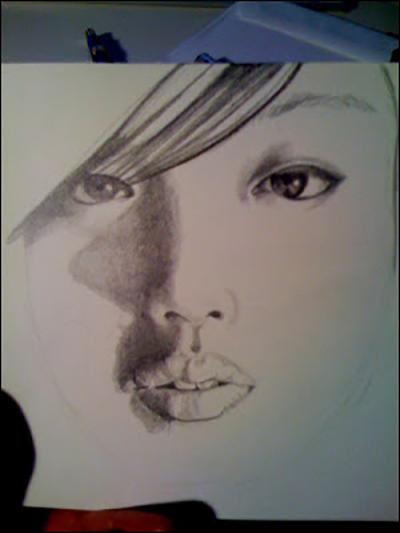
Self-Portrait

It was through Mobile UI Patterns, a great design pattern library, that I discovered the creative work of Mari Sheibley, who is currently the lead designer at location-based social networking Foursquare. Here she shares her takes on simplicity, the importance of side projects and the just-do-it attitude when it comes to making things:


Can you please tell a little bit about yourself?
Where are you from?
What do you do for a living?
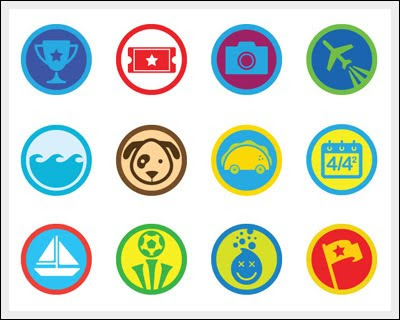
I’m a graphic designer. I was raised in Indiana, went to an art school in Columbus, Ohio, and have resided in New York for the past 6 years. Over the years, I’ve worked in advertising, retail branding, interactive and most recently as the lead designer for a start-up called Foursquare. I manage the overall brand, work on the UI for our iPhone app and design the Foursquare badges (above).


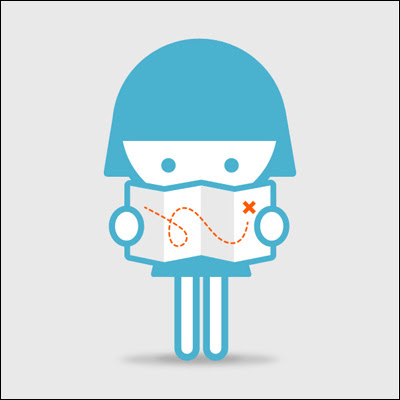
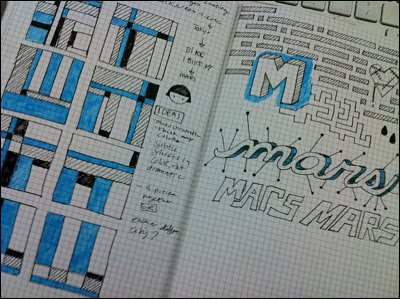
Character “Little Mars”

What is your statement about being a designer?
Generally, I try to use the least amount of elements possible to convey a message or concept. That doesn’t necessarily mean less is more though. As Milton Glaser says, “Just enough is more.” I try and use this approach whether designing interfaces, logos or icons. There’s a balance to include just enough to make something understandable, and finding that balance is the key.

What is your opinion on going from graphic design
to web and mobile design, and how did you make the transition?
I highly recommend it, although I know it’s not always the easiest transition for some people. I was lucky and had opportunities where I could learn web (at a small studio that was just dipping its toes in web design) and later mobile design (with Foursquare) in a forgiving environment where we were all learning.

Writer Alissa Walker wrote an article called
“Women in Industrial Design: Where My Ladies At?”.
Where are the Ladies in Design?
The word ‘design’ covers a huge spectrum of specialization and I think there are a lot of really talented women designers out there. They may skew heavy or light in certain design disciples but I think we’re all over the place.


What tools and materials do you use to work on your ideas
and make them grow?

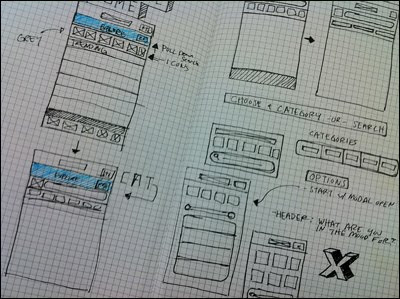
Generally, I have full wireframes created by a UX designer when working on mobile which often times means I can jump straight to the computer. However, that doesn’t mean I don’t also have to go back to the drawing board. I love grid paper (above). Once I get a general idea ready, I use Photoshop for interfaces and Illustrator for icons or badges.

How does time factor into your designing?
It makes me make decisions faster. Sometimes it’s easy to go back and forth on a decision. Is this the right interaction? Is this the right shade of gray? Is that drop shadow the right opacity? Does this make sense for the user? When I’m strapped for time sometimes, I just go with my gut feeling. The great thing about working on interactive (and more importantly on one product) is that you’re never finished. If you hustle to get a build out and it turns out something isn’t right you can always go back and fix it. There’s something truly amazing (and a little frustrating) when you know your work is never finished.

What is the most rewarding part of being a designer?
Knowing that something I made is making someone’s life easier, more enjoyable or more beautiful. Seeing a random person at a restaurant checking into Foursquare or someone I’ve never met sporting a Mayor Crown shirt or someone tweeting at me that they’re using mobile-patterns.com to help them design their own app is a great feeling.

Was there a part of your work that was particularly trying
and how did you deal with it?

The hardest part is thinking about things holistically and keeping everything consistent. It’s easy to make one view or screen of the app beautiful, but do those patterns and interactions make sense elsewhere in the app? And not only elsewhere in the app, but does it make sense in the Android app and on the website? Sometimes you just have to think big picture and accept when you have to let go of something because it doesn’t work everywhere.


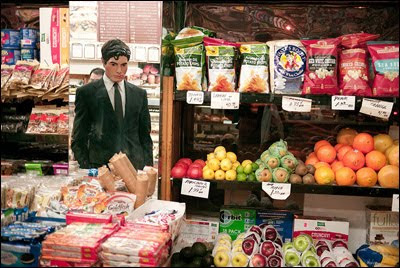
The New Adventures of Superman


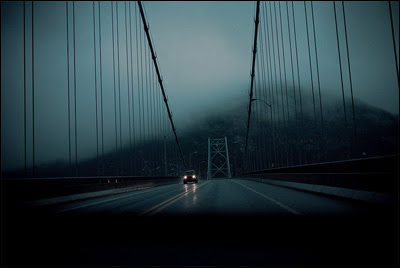
Bear Mountain Bridge, New York


Painting in Progress

How do you stay creative? Do you draw? Or keep a journal?
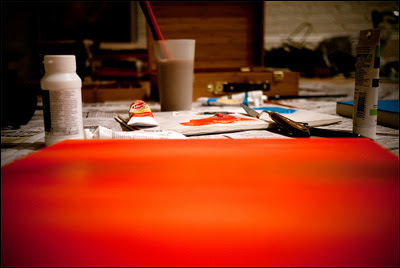
To help combat working on one thing, I take a lot of photos (above) and give myself little side projects; anything from videos to typography projects. I still draw a little (self-portrait above), although not as much as I’d like and recently started painting again (above). I keep a journal as well; I’ve done so since I was 13 years old. It’s important for reflection and remembering certain parts of my life that would otherwise be lost in the jumble of my brain.

What are some of your sources of inspiration?

It sounds completely cliché but New York City is a huge inspiration to me. There’s always weirdly beautiful things happening everywhere. My friends are also really inspiring and keep me trying to work harder and be better at everything I do. Other than that, I use my Tumblr dashboard for bursts of inspiration. I follow a handful of artists, designers, photographers and writers whose short form posts always inspire me.


What is your advice to people who aspire to be a designer?

Just do it, you only get better with practice.

• • • 

Update, April 29, 2013: After four years, Foursquare’s first designer Mari Sheibley left the company “to tackle new problems and help other entrepreneurs bring their vision to life.”

• • •

Read more from Design Feast Series of 101 (so far) Interviews
with people who love making things.


Donating = Appreciating: Design Feast is now on Patreon!
Lots of hours are put into making Design Feast—because it’s a labor of love to provide creative culture to everyone. If you find delight and motivation from the hundreds of interviews, including event write-ups, at Design Feast, please consider becoming a supporting Patron with a recurring monthly donation.

Please help keep Design Feast going and growing by visiting my Patreon page where you can watch a short intro video plus view my goals and reward tiers, from $1 to $12—between a souvenir and a satisfying brunch.

March 9, 2011

Of Women and Humor: New Yorker Cartoonist and TED Speaker Liza Donnelly


Published on Womensenews.org

Liza Donnelly is a Cartoonist who joined The New Yorker in 1982. She was the youngest among the staff and one of only three women to hold the role. Her experience led to writing and publishing the book Funny Ladies: The New Yorker’s Greatest Women Cartoonists and Their Cartoons. She is a part of many cartoon books. In 2007, Donnelly was one of the original cartoonists invited to join Cartooning for Peace, an initiative of the United Nations. In 2011, she spoke at the first TED Women conference. Though her TED Talk was short in length, only a little over six minutes, it was long in humor. Here, she shares her thoughts about these experiences and making work charged with laughter, one of the best forms of medicine:

Can you please tell a little bit about yourself? Where are you from? What do you do for a living?
I was born in Washington, DC, and am a contract cartoonist for The New Yorker Magazine, having been with them for 30 years. I also write essays and do drawings for many other publications and websites. I have taught at Vassar College, and am a public speaker as well, having spoken at TED and The United Nations. My numerous books include a history of the women cartoonists of The New Yorker, and my most recent book is a collection of my own cartoons called When Do They Serve The Wine?.


What is your statement about being a cartoonist?
Perhaps because I grew up in Washington, I love politics, and wanted to be a political cartoonist from an early age. But my cartoons now are not all political, rather, they reflect our culture as well. In my work, I like to make viewers think a little bit, as well as laugh.

What do you mean by “laughing at ourselves”?
We get caught in ruts—ways of thinking and behaving. Humor can sometimes shed light on the stupid things we say and do. Humor is a good way to expose those things, and I do it gently in my cartoons. I don’t like to hit people over the head with my humor. I think it can be more effective to quietly expose, actually.


© Liza Donnelly and The New Yorker Magazine

Writer Alissa Walker wrote an article called “Women in Industrial Design: Where My Ladies At?” Where are the Ladies in the creative fields-at-large?
Women are still not recognized as much as they should be. There are a lot of reasons for that. I don’t think that editors are actively sexist, rather, the reasons are more complicated. Perhaps women are not submitting work as much as men, perhaps the standard of the creative endeavor is still male-oriented. In my field, humor, I know there has been a bias against women being funny, and it lingers. Historically, women were not encouraged to enter the humor business, or even be funny inter-personally. That’s changing, but the effects of that still linger. And, as I said above for creative endeavors in general, the standard for what’s funny is still a male standard for the most part. We can and do all laugh at the same things, but humor has typically been the kind that men find most funny. As I said, it’s complicated, and is difficult to explain the nuances in a short interview without sounding like I am a separatist, which I am not. There is not “women’s humor” and “men’s humor” per se, but the creative approach that women take can often be different than those of men, and is not always recognized as “good.”


© Liza Donnelly and The New Yorker Magazine

What tools and materials do you use to work on your ideas and make them grow?
I use newspapers and news sites to get seeds for ideas, be they trends or specific words. I keep a notebook of these things, and sit with them and sheets of paper and doodle to see if I can work them into an idea. It is still a rather mysterious process, as you never know how an idea comes to be. You have to keep your mind loose, and listen to yourself think. Sometimes an idea comes out of nowhere, and you need to be alert for them when they do!

How does time factor into your drawing and publishing?
For my weekly cartoons, I have to be careful to leave time for the creative process to work. An open day of no responsibilities is a perfect day for creating cartoons. For publishing, my books take from several years (as in the history I wrote, which involved a lot of research) to one year to put together.

What is the most rewarding part of being a cartoonist?

Making people happy. And being able to do what I love.

Was there a part of your work that was particularly trying and how did you deal with it?
Rejection is constant in this business, and that has been and still is difficult to deal with. Almost every cartoon one creates is like a special child, and when it is not bought, you feel angry and hurt. One has to learn to just move on to the next week’s work. I still have a lot of trouble with that.

How do you stay creative? Do you draw? Or keep a journal?
Since I do a weekly batch of cartoons of about 6–10 drawings, I think I stay creative that way. It’s good to keep the wheels oiled, working every day. Taking vacations (which we rarely do) are hard to recover from sometimes. I keep my notebook of weekly idea seeds, and a journal of my work endeavors.

What are some of your sources of inspiration?
Life, in general, is my inspiration. I love people watching in New York City, and looking at cartoon collections of some of my favorite New Yorker cartoonists.

What was the experience like being part of TED’s debut TED Women conference? And any tips and lessons to be a good presenter?
Speaking at TED was amazing. It is a high-powered atmosphere, but very friendly at the same time. You are challenged to do your very best. How to do that? Practice, practice, practice... and simplify. Bring in a little bit of yourself, and don’t be afraid to show vulnerability. The audience wants to know you are human.

What is your advice to people who aspire to be a cartoonist?
Draw all the time, and don’t give up. Persistence is half the battle. Find a voice that is your own.


© Liza Donnelly and The New Yorker Magazine

How can people see your work and buy it?
People can see my work in The New Yorker, their e-commerce site, cartoonbank.com. They can buy my books and visit my site and blog.

• • •

Liza Donnelly’s books include When Do They Serve The Wine?, Funny Ladies, Sex and Sensibility, Cartoon Marriage. Stay in touch with Donnelly on her blog and on Twitter.

• • •

Images courtesy of Liza Donnelly.

• • •

Read more from Design Feast Series of Interviews with people who love making things.

• • •


Now available – BROKEN: Navigating the ups and downs of the circus called work! Buy now.


Thanks for reading so far this Design Feast interview.

Read this full interview and more by supporting Design Feast on Patreon. If you’re able to, please become a Patron of Design Feast today from $1 and up—it only takes a minute. Your monthly contribution will give you full access to this interview and those upcoming with extraordinary creators and their perspectives. Stay both informed and inspired.


What will stay free to completely explore at Design Feast are the 344 insightful interviews with an incredible range of Designers, Bloggers, Makers and realizers of Side Projects.

March 2, 2011

Problem Solving and Observation by Software Engineer plus Photographer Ingrid Truemper


Photo by Aaron Estrada

It was at a course taught by Human Factors International where I met Ingrid Truemper. Her enthusiasm for software engineering is matched by her practice of photography. Here, she shares her thoughts about being active in making Webapps, “drawing with light,” and living in a city where art and technology thrive:

Can you please tell a little bit about yourself?
Where are you from?
I was born in Cleveland to German immigrant parents, and grew up in Dallas. I’ve lived in Switzerland, Michigan, and London, and now make my home in Albuquerque, New Mexico.

What do you do for a living?
I’m a software engineer with a large tech company. I work for an internal consulting group, whose employees get contracted out to a variety of business units, so the nature of my projects often change.

My work is typically in Web application development: I design, code, and support the Web-based software that internal employees and external customers use to support their business processes.

What is your statement about being a software engineer?
Software engineering is an extremely creative, collaborative job that offers a high degree of freedom and flexibility, as well as great quality of life.

How did you get interested in the world of software
and become a part of it?
Growing up, my mother was a programmer, and my father was a computer science professor, so maybe it was inevitable that I ended up where I am! They always encouraged me to pursue technical studies, and I experimented with programming at a young age, but then lost interest until much later.

It wasn’t until I had my first job working as a Web and print editor for a publishing company, and coded content for the publisher’s Website, that I realized this was something I enjoyed and could excel at. I went back to school 10 years ago for a Master’s in computer science, and have worked as a software engineer ever since.

Writer Alissa Walker wrote an article called
“Women in Industrial Design: Where My Ladies At?”
Where are the Ladies in Technology?
Girls are often not taught to have a sense of confidence with technology and figuring things out for themselves. They may not perceive themselves as having the ability to do technical work. Women also sometimes have a false perception that software engineers sit alone in a cubicle all day writing code. In fact, constant communication and collaboration are essential to developing successful software.

Girls also may be turned off by male-dominated geek culture, but you don’t have to be into geek culture or gaming to be a successful developer. I believe that anyone who is persistent, a logical thinker, and enjoys puzzles or problem-solving can be a good software engineer—the rest is just learning the trade. Women are often detail-oriented, patient, and good communicators—all attributes of an excellent software developer.

How does time factor into your work?
What tools and materials do you use to work on your ideas
and make them grow?
There is never enough time for everything I want to do! I stay organized at work by using a text file, as a scratchpad, that contains my to-do list as well as various notes, with the items organized by priority. All day long, I make notes and rearrange items on the list. It’s a simple, low-tech solution that works well for me.

In my personal life, I follow the goal-setting process suggested in the book Creative Visualization. Every six months or so, I get out a notebook and brainstorm my goals for the next month, two months, six months, five years, 10 years, and for my lifetime.

I’ve also experimented with some of the other techniques in the book, such as creating treasure maps that symbolize your goals. I’ve been doing that for about eight years, and when I look back at my older goal lists and treasure maps, I’m amazed how much I have achieved.

You also practice photography. How did you get interested
in this and does it influence your work?
My parents gave me my first film SLR [single-lens reflex camera] when I was 17, and I’ve been hooked ever since. In the last five years, I’ve been using digital SLRs; currently, I have a Nikon D90. Digital technology has simplified the photography process tremendously, but sometimes, I get nostalgic for the days of the traditional darkroom. There was something magical about watching your print slowly appear in the tray!


Stone Cliff Winery, Dubuque

My programming work and interest in the visual arts intersect at times. Usually, I don’t have the luxury of having a human factors engineer or designer on my team, so I often find myself in the design space. I’ve been educating myself on user-centered design, as well as recently starting to take formal training. It’s an important aspect of software development and one that is often neglected, particularly with internal applications.


Disney Performing Arts Center, Los Angeles

What is the most rewarding part of being a software engineer?
Getting to use your brain all day long is a privilege. There never is a dull moment, and there is so much to learn. I spend all day researching, coding, and collaborating on problem-solving.

Was there a part of your work that was particularly trying
and how did you deal with it?

It’s ironic that the aspect I like most about my job can also be the one that is most trying. The rapid development pace of technology is a double-edged sword for software engineers. It’s a great field to work in if you love lifelong learning. On the other hand, the breakneck speed of innovation can be overwhelming. It’s hard to keep up, even if you specialize in a single niche.

I keep up with changes as much as possible by reading technical journals and attending user groups and training, reading blogs and news sites, and listening to podcasts like This Week in Tech.

How do you stay creative? Do you draw? Or keep a journal?
Photography is wonderful for honing your observation skills. I’m always scanning my environment looking for potential subjects. I try to focus on out-of-the-way spots. I have a hobby of photographing street art and murals; it is amazing what you can discover if you just wander and keep your eyes open.


Mural, Albuquerque

Travel also helps me break out of my usual way of thinking and seeing things. I try to take at least one international trip a year, and return with a fresh perspective on my life and goals.


Kayaks, bridge to Djurgården, Stockholm

What are some of your sources of inspiration?
Digital technology has unleashed a global explosion of photography. There are so many talented amateurs. I use Flickr as a venue for viewing others’ work, learning new techniques and getting subject ideas, and interacting with other photographers around the world.

Living so close to Santa Fe is fortuitous, as so many talented photographers make their home there. I belong to a local photography club that invites a professional photographer to speak each month, and it’s always inspiring to see their work and hear their stories.

What is special about Albuquerque, New Mexico?


El Día de los Muertos parade, Albuquerque

I feel very fortunate to live in Albuquerque; to me, it’s one of the country’s best-kept secrets. It has the same unique blend of Anglo, Hispanic, and Native American cultures; striking high desert scenery; and laid-back lifestyle as Santa Fe or Taos, with a much lower cost of living. Like those other towns, Albuquerque also has a vibrant artistic community that is attracted by the area’s unique landscape and culture.


Abandoned ATSF railyard, Albuquerque


Window, Abandoned house, Abeytas, New Mexico

What is your advice to Ladies who aspire to enter
and engage the world of software?

Don’t let yourself be intimidated. Try taking an entry-level programming class at a local community college. Or check out a Web design class: Many women become interested in Web development by starting off in design. If the creativity and joy of problem-solving strikes a chord in you, software or Web development may be for you.

Once you complete your education, look for a company that has a commitment to gender equality. I’m fortunate in that my employer strongly supports women in technical professions, as well as maintaining a work-life balance. That can make a big difference in your job satisfaction.

• • •

Photographs courtesy of Ingrid Truemper.

• • •

Read more from Design Feast Series of Interviews
with people who love making things.


Please consider supporting Design Feast
If you liked this lovingly-made interview, show your appreciation by helping to support my labor of love—Design Feast, which proudly includes this blog. Learn more.