Showing posts with label Webapps. Show all posts

September 28, 2011

Tools to Make, Manage and Publish Your Creative Portfolio Online


Portfolio icon designed by Nicolas Vicent from The Noun Project collection

Presenting your work online—be it art, design, photography—can be tough. Equally tough is building and updating your online portfolio. Here’s a starter list of tools that help present and share your work:
Know of another great tool or community that helps display creative work? Please do recommend.

September 18, 2010

Minimize the Language Barrier between Designers and Developers


Photo by Rob Lambert

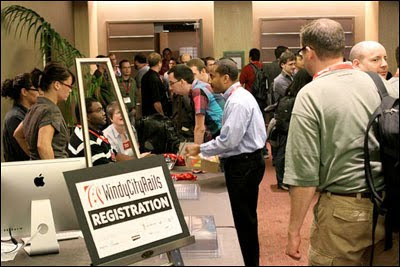
In contrast to the developer’s language of code and software frameworks is the designer’s language of typography and information visualization. One session at the Windy City Rails 2010 conference that piqued my interest was by Ryan Singer, Product Manager and Lead UI Designer at 37signals. He talked about “Weaving Design and Development”. Sharing this post is colleague Graphic and Web Designer Robert Walsh who will also give his thoughts on Singer’s presentation.

What were the memorable takeaways?

Nate: Singer was gracious to spend some time afterwards. Connecting to one of the points in his presentation about designer and developers starting early, at the same, I told him that seeing working software at the get-go (or should I say “git-go”) is a sensation. Making ideas for an interface, no matter the fidelity, is great. But grounding the sketches, the wireframes, and translating them into a live iterative interface that’s interactive in a browser, on a mobile device, is huge. Designers having direct access to developers, and vice versa, helps a lot. It promotes proactive feedback, even continuous feedback—As Singer put it, “Realizing that something sucks and make it better.” This way, designers and developers escape flatland, from sketch to screen, together.

Robert: An underlying theme of his presentation, that I don’t think became explicit until the question and answer session, was that Singer had entered the ongoing debate about the necessary capabilities of web designers. To him, a designer should be able to work in the view templates throughout the life of the application. Therefore, the designer should be writing the HAML or ERB, CSS or SASS, and be in Terminal constantly pulling and pushing to GIT. I also noticed that it surprised the programmers in the room when he added that a designer should be comfortable working in Rails enough to write small snippets of Ruby in a view or create a helper when necessary.

I spoke with him after the session and I get the impression that he is of the population that thinks in the next 5–10 years or so there will be a generation of designers who grew up designing for the web and these will be the strengths that they have picked up over time by just being active creative citizens of the web.

What about the presentation’s style?

Robert: I thought that his opening story—while obedient to the practice of opening with an emotionally gripping story—was long-winded. The ‘aha’ moment comes at the end of the story and I think the fact that he took so long to get there kept the energy low initially.

More so, regarding style, his content and delivery were textbook “37 Signals iconoclasm.” As a designer, he had no reservations at bluntly saying HAML was unnecessary (to which a wash of gasps covered the room) or other things that seemed to go against popular opinion. Namely, the role of the designer in the process of creating a web application.
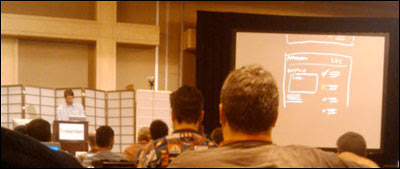

Photo by Nate Burgos

Nate: It was refreshing to see live digital sketching (above) to illustrate Singer’s lecture. With the black backdrop serving white and red strokes, I thought they were using their iPad app Draft but turned out to be a large canvas, perhaps Photoshop. The overhead projector has become more extinct. And starting a presentation with a relevant story is always a good method to gel all the key talking points, as long as the story is relevant, and even better when it has humor as Singer did in his telling.

In closure, when it comes to language, designers and developers work their native way of making something. Their respective languages can collide but they converge toward accomplishing a shared goal: a good product to help bring a good experience to people.

• • •

A version of this piece was published at the blog of custom software developer Pathfinder Development.
April 21, 2009

Four Brothers, Webapp Style


Viewbook allows people to easily create and share image galleries and portfolios. But the most important feature, to me, is that it’s a family labor of love. Four brothers—Rien, Alrik, Paul and Rudin Swagerman—engage many aspects of their product’s life: web development, marketing, interface and interactive design, business strategy. When I was in design school, I was encouraged by the belief that a first wave of work experience should be pursued with family members. And this remains good advice.

To kick it up a notch, family members can also be work partners, as Viewbook demonstrates. It’s worth noting that their Viewbook collaboration was born from identifying missing elements in their work. Not easy to do, but such insight can lead to innovative creations. Family members can be the toughest clients. I assume that the four brothers of Viewbook demand a lot from each other in striving for quality in everything that they do. But it’s all in the family.

April 13, 2009

How 37signals’ Backpack Made Me Like Gmail

You don’t have to be a girl to enjoy The Geek Girls Guide, created by Nancy Lyons and Meghan Wilker. I was thrilled to contribute an article for the blogging duo. My first contribution is about my use of the webapp Backpack, which greatly helped simplify my inbox. Big thanks to the Geek Girls Nancy and Meghan for the writing opportunity, and at the same time, making use of Backpack. Enjoy the article.

December 26, 2008

Women, Web 2.0 Style


There’s much PR about men contributing to the tools and toolkit of the Internet. Let’s not forget about the women who are shaping and making the future of the web, 2.0 and thereafter. Their contributions deal with the design of web-based products and services that foster user interaction with information. Fast Company magazine has a sampling of some of these netpreneurs.

Related: 8 Experts Predict How Web 2.0 Will Evolve In 2009

[Nifty Idea] CollabFinder


At the same time people our pursuing the great novel or screenplay, many are also kicking around an idea for the next great web site or application. Searching for that particular designer or developer who can help bring that dream to life, however, can take a long time. To help ease this type of search, Boy Girl Talk, LLC, created CollabFinder. Let your design collaboration-quest begin!

November 18, 2008

Designing the User Interface of MetalMiner IndX(SM)


Making a webapp is hard work. Yet, with all the coverage about the advancing potential of webapps—their development and adoption—collaborating on the design of a webapp is a decidedly cool thing to do. My friend Lisa Reisman gave me this opportunity. Her business, Aptium Global, specializes in materials sourcing: helping companies save and better strategize on the spending of natural and artificial resources used to manufacture their products and services. One kind of material that Lisa is especially passionate about is metals. From her company’s blog, “This may sound sad, but it’s true: We lie awake at night thinking about how manufacturers could save (or avoid spending) money on their metal purchases. It’s a strange thing to think about, but alas, someone has to do it.” Yup, Lisa’s a bona-fide metals geek. And geek is chic, totally, in this case.

Lisa shared her idea about a pricing tool for metals. Dubbed MetalMiner IndX(SM), this webapp would provide cross-country pricing data about a variety of metals, from aluminum to steel. The goal is to help metal analysts, consultants, and financial services firms to make better decisions about acquiring metals. While the premise is simple, as filmmaker Martin Scorsese has claimed, “There's no such thing as simple. Simple is hard work.”

Lisa provided a description and sample data points of the webapp. I took what I could understand and began sketching. Jason Fried of 37signals wrote a piece about drawing user interfaces with a markie. But I’m used to using a pencil or a pen to paper. Speaking of which, a blank sheet is my preference, rather than graph paper. Sketching on paper without lines is a better canvas to me. User interfaces are essentially layouts. With each iteration I played with the arrangement of the elements, while trying to keep in mind what’s sensible. I wanted the layout to be divided into two parts: The primary space would be for the criteria to adjust and search for pricing a particular metal; the other space would be dedicated for displaying the results.


Next, I interpreted one of the sketches via a digital format, not Photoshop, a page layout program. May sound backwards, since UIs are screen layouts not page layouts, but I’m honing in on the general content placement, whether it’s a form field or text.


Building the webapp based on these sketches, we watched the user interface evolve as the actual visual and interactive factors were incorporated. Such changes are part of the process from sketch to reality. MetalMiner IndX(SM) launched last month. No Beta in the webapp’s name, a straightforward launch, and an exciting one at that!