December 26, 2010

Illustrator Laura Barnard’s Urban Tapestry


In Illustrator Laura Barnard’s work, the city is reinforced as a fascinating grid of point, line and plane. Barnard is a self-proclaimed “Purveyor of cityscapes” and her intricate drawings clearly show her passion for the patterns that only cities can produce. The city is her canvas. Here she shares her thoughts about being an illustrator and her specialty of visualizing the metropolis.

Can you please tell a little bit about yourself?
I’m from the UK, just outside London. I’m fortunate to live on a very well-connected train route to various cities, so have almost any type of building at my drawing disposal, so I wouldn’t have it any other way.

What do you do for a living?
I’d describe myself as an illustrator—after many years of struggling in all sorts of jobs, from warehouse picking to cleaning to collecting the money out of parking meters, so I’m very proud to say that illustrating is what I do exclusively now.

What is your statement about being an illustrator?
My main approach is to be friendly, reliable and professional, at the same time as producing high-quality work. I think that’s so important. Half of the job is about the commercial side of it and fitting in with whom I’m working with, so that’s as important as producing great work.

What tools and materials do you use to work on your ideas
and make them grow?

For commercial work, I draw straight into Photoshop with a Wacom tablet. This is quite a recent development, as I used to scan in the ink (well, gel pen) drawing. It just makes more sense to work this way when so many jobs have a fast turnaround or need last minute changes, and I ’m also starting to like the really black line generated more and more.

I use the pencil tool in Photoshop, it’s quite like a bitmap scan of ink in the end:


I do try and keep up with analogue tools as well though, it’s a great way to experiment with marks and it’s still the quickest way to get ideas out of your head.

I also do pen and ink commissions from time to time and that’s always a great way to keep you on your toes. There’s no undo with ink.


What makes the city and its landscape a special focus
for you and your art?
I think for me it’s a mixture of landscape, sculpture and space all together. I’ve always been a city kid, and I think they’re just my version of windswept country landscapes, really. I love the details, and the funny angles, and the mixture of buildings all butted up together, and I love that feeling that anywhere you look there are several stories all under the surface that none of us know about.

You’re also exploring lomography and photography on
the iPhone. How are these methods influencing your work?

If I’m perfectly honest, probably not that much! I’ve always separated the photography I do from the drawing I do—I’m not sure why. I think I’m trying to do different things with both, and quite often the photos I take are much simpler in composition. I’ve always love cheap cameras, ever since I was given a 110 camera when I was very small, so the fact that a little smartphone can replicate some of that Lomo spirit is quite exciting.

When I do take photos to draw from, they tend to be deadly boring to anyone but me (possibly even boring to me too) and document things.

How does time factor into your making of illustrations?
Well, I have totally shot myself in the foot by specialising in the most detailed drawings imaginable so that was REALLY stupid.


Seriously, though, they do take a fair while to do, so I’ve branched out into some other ways of looking at the city—characters, for one, and also some slightly more minimalist ways of filling the page with pockets of detail and some space as well. Not everyone’s got the time or the budget to commission something super detailed so it makes sense to diversify a bit.

Another thing I’ve been doing a far bit of is patterns and repeating work—again, it’s another way to alter how long a drawing takes.


What is the most rewarding part of being an illustrator?
Well, I get to draw every day and people pay me money for it! That’s pretty damn cool. I love being my own boss and being reliant on myself, and some of the harder parts, such as uncertain earnings, more than makes up for that. I also expect that some of the harder parts like money or having to take certain jobs will get easier to manage as time goes on (it has so far), which means it gets even better, so that’s super.

Was there a part of your work that was particularly trying
and how did you deal with it?

Not really—there have been some jobs that are harder than others or ones that have been harder to complete, but you just have to find a way round these things. And there always is a way round!

I do tend to get UTTERLY sick of the detailed stuff as I’m coming to the end of each one, but it’s always worth it in the end.

How do you stay creative? Do you draw? Or keep a journal?
I’ve found, since I’ve been working from home and not commuting, I’ve been much less likely to keep a sketchbook, as outside trips tend to be with a specific project in mind, or to go out and buy teabags. That is something I’ve been intending to address though, just as soon as I get some free time to work on it.

What are some of your sources of inspiration?
All sorts of things. I’m pretty tired of the usual places to look, like design books and some of the usual design blogs. The blogs and books that I still enjoy (and there are some great ones out there) are the ones that I won’t see the same work on or in as anywhere else and seem to have a different mindset from “the next trendy thing”.

Apart from that, old books about space travel and train travel, or 1960s architecture, or brick patterns, or weird packaging from old kitchen equipment in charity shops or books of old stamps, that’s the stuff I find really inspiring. I’m lucky enough to live within walking distance of a whole load of charity shops and a library, and they’re brilliant places to get a bit lost in.


What is your advice to people who aspire
to be an illustrator?
Don’t choose the most complicated subject IN THE WORLD to specialise in. Embrace minimalism.

No, I think the most important thing to remember is that absolutely everyone feels at the end of their tether sometimes and just to keep plugging away. It can all feel totally hopeless one minute and then something really exciting comes along, particularly if you make something exciting come along.

How can people see your art and buy your work?
I have a website at www.laurabarnard.co.uk and a shop within that at www.laurabarnard.co.uk/shop. Thanks for taking the time to read my ramblings.

• • •

Images courtesy of Laura Barnard.

• • •

Laura Barnard was discovered via Boneshaker Magazine, “a celebration of cycling and the people who do it.”

December 20, 2010

Blogger’s Quest(ionnaire): Small Notebook’s Rachel Meeks is a Champion of Simplicity at Home


The title of Rachel Meeks’ blog Small Notebook refers to two main qualities of living. One is a lean lifestyle marked by less clutter and distractions to help sharpen focus on family, one’s self and things that matter. The other is Meeks’ preference to write in notebooks where you’ll find stick figures like this:


Meeks admits, “I don’t have it all together. I don’t expect for you to have it all together, either.” When it comes to achieving “a home that is welcoming and peaceful, without clutter”, it’s a persistent and steady work in progress which Small Notebook is and continues to be in every encouraging post to help people live a simpler life. Her lessons about web-based publishing may help your entrance into the blogosphere or further inform your current work in it:

Why did you create a web site of regular entries?
To encourage women to create a simple and peaceful home. A blog adds the personal effect that someone else can relate to, and maybe they will say, “If she can do it, then I can do it too.”

What web-based solution did you select and why?
I use WordPress because it’s so customizable, but I’m also interested in simpler platforms like Tumblr.

What is your definition of a good blog and what are
three good blogs that you frequently visit?

A good blog is one that shares thoughtful content or imagery even when it has only a couple of readers. I read SimpleMom.net, InspiredToAction.com, and SortaCrunchy.net, and now that I think about it, those are written by people I know in real life. I keep a short list of blogs that I follow on a regular basis, and the rest come and go from my RSS reader to keep it manageable.


How do you create content for your blog?
I think about what’s interesting to me at the moment, I consider how it’s relevant to others, I try to communicate an idea with a story using as few words as possible, and then I take or draw a picture. Then I try to add a headline that’s not too bad, I read it over again for mistakes too many times, and finally, I hit publish.


How do you stay organized and motivated
to contribute to your blog?

I use Evernote to keep my ideas organized. My motivation ebbs and flows, so I try to stay balanced and recognize when I need to pull back from it a little. If I don’t have any new ideas, I don’t sit in front of the computer screen. I get up and work on something else, and an idea will eventually show up.

For those aspiring to make a web site composed of
regular thoughts and/or images, what is your advice?

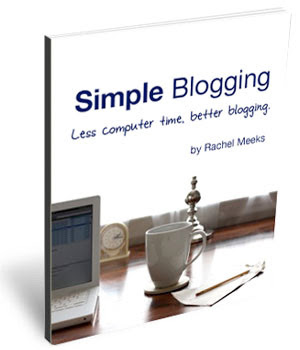
Blogging can take much more time than you originally think it will. I had no way to expect what it would do to my email inbox. I’ve learned not to place too much value on other people’s praise or criticism. I’m passionate about helping women spend less time on the computer while still growing a successful blog, so I wrote an e-book called Simple Blogging. It’s full of advice about how to grow your blog while staying balanced with your time.


What is your quest in blogging?

To provide encouragement and practical advice, and to help other people feel like here is someone they can relate to.

• • •

Doodle and photos courtesy of Rachel Meeks.

• • •

Read previous Blogger’s Quest(ionnaire) with GreenAroundTheGlobe and their Travels and Discoveries in environmental sustainability.

December 11, 2010

Painter Pete McKee’s Common Touch


Photography by Chris Saunders

In “Frank and Tiddles”, a cat is observing a fish in a bowl. The cat is either admiring from a distance or contemplating dipping paws into the fish’s sanctuary, equipped with a sand castle. In “Her Favourite Things”, a girl is looking out the window. She’s wearing headphones, listening to her favorite vinyl, with record sleeve in both hands. There are pictures hanging on the wall, and next to a resting guitar are a glass and bottle filled with red wine, her preferred beverage as she relaxes in her private world. In “Cockles in Castle Market”, which is part of the series “22 Views of Sheffield”, two gentlemen are sitting at the bar in a restaurant: one is eating, the other is looking around. These are ordinary moments in everyday settings painted by Pete McKee. His source of inspiration is his hometown of Sheffield, England. His artistic scenes take pride in the usual. They depict working class roots and the activities of youth.

McKee’s visual approach was described by fashion designer Paul Smith as an “economical modernist style”. There is a strong sense of economy in McKee’s work: distinct shapes, bright colors, uncluttered compositions. Most of all, there’s clarity. What’s apparent is the humanity of McKee’s focus, whether it’s the beach, the pub, the train station, the bus stop, a room or anywhere else the pace of humanity takes place. I suspect that this is why the cartoon painter’s website is called “The Real McKee”. Nothing ordinary about that. Here he shares his thoughts on why and how he does his work.

Can you please tell a little bit about yourself?
Where are you from?

I’m 40-odd years old and from Sheffield in England. I like long walks in the park, watching French films and doing crosswords, hahaha…

What do you do for a living?
I paint pictures for a living but before then I’ve been a shop assistant, a mailman, a shelf stacker and a gag writer for greetings cards.

What is your statement about being a painter?
Honesty. If you paint with genuine integrity and a true feeling for your subject, then you will sleep soundly at night and the people looking and buying your work will know you are not a fraud.


What tools and materials do you use to work on your ideas
and make them grow?

A blank MDF board, a 2B pencil, a large rubber gum eraser, a felt marker, several small pots of household emulsion paint and a vivid imagination.

What makes Sheffield, England, a special place for you
and your art?

Sheffield is a tough, beautiful city with lots of trees and parks next to plenty of empty factories but full of people with an independent character who thrive on self-deprecation.


Sea Breeze

Why do ordinary moments and subject matter
like
the working class and youth culture fascinate you?
A young Ray Charles was once told not to impersonate Nat King Cole but to sing and play in his own style. Hearing this was an epiphany to me and the very next day I began creating works about my life and the things I know, and I never looked back.

The great thing about the working class and youth culture is that both are very emotive subjects that people feel passionate about. Quite often the small things mean the most to people like shopping with your gran on a Saturday morning or eating coco pops while watching cartoons.

Your paintings attracted the attention of Noel Gallagher
of the rock band Oasis, Cartoonist Matt Groening,
plus Filmmaker George Lucas. Why do you think your work
appeals to them?
I assume for the same reasons as everyone else who likes my work, it’s the common touch.

How does time factor into your making of paintings?

Well, at the moment, there’s not enough time but there’s nothing finer for finding a creative idea than those empty moments in your head like when you take a shower or brush your teeth. As for time to create the painting, then there’s nothing better than a deadline.

What is the most rewarding part of being a painter?
People’s reactions.

Was there a part of your work that was particularly trying
and how did you deal with it?

Nothing springs to mind but I tend to put too much work on myself when I’m late with deadlines and I’m up till 3 A.M. finishing an exhibition off and then driving across the country the next day to hang it.

How do you stay creative? Do you draw? Or keep a journal?
I’ve never kept a journal. I often have grand ideas of documenting holidays and trips but I end up enjoying myself instead by drinking beer and reading books. But there is seldom a day goes by where I’m not drawing, and drawing is a skill that requires a lot of practice.


Game King

What are some of your sources of inspiration?
Memories are my main port of call for inspiration but I do get inspired to create if I’ve seen a good film or watched a fantastic gig, even the odd piece of art has inspired me too.

What is your advice to people who aspire to be an artist,
a painter?

Talent’s not enough, you need to be determined have an ego the size of India if you want to sell your work. If all you want to do is paint or create works for your own amusement then get a good rubber [eraser] and enjoy yourself.

How can people see your art and buy your work?
Your first port of call is my website, www.therealMckee.co.uk

• • •

See Libre Film Director Vianet Djenguet’s wonderful short documentary “The Real McKee: A Northern Soul”.

• • •

Big thanks to friend, collaborator and business partner Steve Dale for making me aware of Pete McKee and his art.