December 27, 2009

Blogger’s Quest(ionnaire): Project Manager Andrew Wicklander and Founder of Ideal Project Group


I discovered Andrew via comments to a post at 37signals’ blog Signal vs. Noise. This makes perfect sense considering that his frequent tool for working is their Webapp Basecamp whose purpose is to run projects better. Speaking of running projects better, Andrew is the CEO of Ideal Project Group which specializes in IT Project Management. His blog is Project Idealism where he writes about “project management, technology, business, entrepreneurship and other related opinions.” His sustained web-based publishing experience may help your entrance into the blogosphere or further inform your current work in it:

Why did you create a Website of regular entries?
Working the way I do, I’m often interacting with numerous clients in different environments. My blog is sort of my “stake in the ground” about business, technology and project management. It’s one of the few things that is all mine 100% of the time. I also felt I had a little something to offer to people who may be considering starting their own business. It really bothers me when talented people think the first place they need to look for work is inside someone else’s company. A lot of people have what it takes to work for themselves—they just think it’s harder to do than it really is.

What Web-based solution did you select and why?
I use Blogger because it’s a super simple hosted solution that I was able to get going in 10 minutes without having to install anything.

What is your definition of a good blog and
what are three good blogs that you frequently visit?

A good blog teaches you something you didn’t know, inspires you to do things you’re afraid of, spreads good ideas, and highlights things that aren’t working. It’s really difficult for me to narrow this list down to three. Here’s six: Signal vs. Noise, Sivers.org, Seth Godin’s blog, Five Thirty Eight, Mish’s Global Economic Trend Analysis, ZeroHedge.

How do you create content for your blog?
I have a running list of ideas for blog posts; whenever an idea strikes me I add it to this list. Then, when I’m in the mood to write I visit the list and work on the one that feels right. Sometimes an idea is in the list for only a day or so before I write about it, while others sit for weeks or more. This let’s me think about an idea in the background for a little while before I begin to write about it.

How do you stay organized and motivated
to contribute to your blog?

Other than my running list of ideas, there’s really nothing I do to stay organized or motivated to write. So much of what I work on is date driven that I never even tried to set certain goals for my blog. I love that it doesn’t feel like work to write, and I think setting deadlines for myself would have taken away a lot of the enjoyment. I’ve found that by doing it this way I usually feel like writing a couple times per week which I feel pretty good about.

For those aspiring to make a Website composed of
regular thoughts and
/or images, what is your advice?
Start it. Right now. It doesn’t matter whether it’s Wordpress or Blogger or Tumblr or whatever. Just get it started. Don’t worry about the design—use the default template and start writing. Make it real as soon as possible—you can always modify it later. One of the biggest mistakes I made was waiting so long to start my blog. Writing your thoughts down helps clear your mind, and also allows you to understand yourself in ways you might not have known previously. *Everyone* has something to offer.

What is your quest in blogging?
To provide a place on the web where people can see my unfiltered opinions about my profession—and hopefully earn some clients and inspire a few people along the way.

• • •

Photograph courtesy of Andrew Wicklander.

• • •

Read more of the Design Feast series Blogger’s Quest(ionnaire).


Please consider supporting Design Feast
If you liked this lovingly-made interview, show your appreciation by helping to support my labor of love—Design Feast, which proudly includes this blog. Learn more.

Design and Metals: Ada Lovelace, Urban Cycling, Naked Coca-Cola Packaging, Chihuly’s Cultural Corridor

In December 2008, I began writing about the intersection of design and metals. Taking a cue from designer Eric Baker’s sequences of found images that he regularly posts on the blog Design Observer, here’s an array of clickable images from recent stories concerning metal as a design medium:


December 20, 2009

Designer’s Quest(ionnaire)s: Designer Sophie Henson and Design Researcher Brianna Sylver

The Designer’s Quest(ionnaire) is a Design Feast initiative that describes and captures a designer’s perspective in a succinct format:


Per my regular online regiment, I explore Dave Cuzner’s blog Grain Edit, especially the comments, where I discovered London-based illustrator and designer Sophie Henson. Her work—whether it’s Editorial or Animation, including Apparel—is a rich contrast of shapes and lines. There’s lots of fun in Sophie’s visual language (see her Twitter background) and in her thoughts about making a message both communicative and appealing.


I met Brianna Sylver at the Illinois Institute of Technology’s Institute of Design, originally founded as the New Bauhaus. She is the founder and owner of Sylver Consulting, an international firm passionate about design ethnography. Her systematic approach incorporates custom research and workshops. Brianna’s data-intensive way of working speaks not only to a rigorous sensibility but also to a curiosity about people and their relationship to products and services.

Read insightful takes by Sophie and Brianna on design and designing.

Previous Designer’s Quest(ionnaire): Creative Consultant Alex Koplin

December 5, 2009

The Creation and Growth of a Comprehensive Website by Daniel Lewandowski about the Legacy of Pioneering Designer Paul Rand


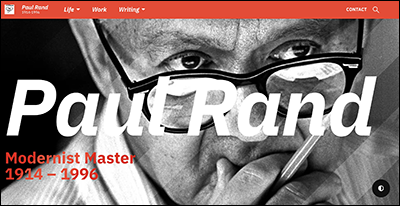
When Daniel Lewandowski discovered that there were no “single-source” references to Paul Rand or his works anywhere on the web, he created a site “meant to honor and pay utmost respect to the life and work of Mr. Rand (1914–1996).” The online tribute and archive is, to use a phrase from its dedication, “sheer pleasure to behold.” Here are Lewandowski’s thoughts about making a tremendous resource celebrating an important designer and writer whose work keeps influencing generations of designers.

Can you please tell a little bit about yourself? Where are you from? What do you do for a living?

Originally from Texas, currently I’m living in Alpharetta, GA, a suburb north of Atlanta. I’m a Sr. Art Director with Digitas. I graduated from the Portfolio Center here in Atlanta back in 1999 with a bachelor’s degree in Graphic Design.

How did you arrive at the idea of doing a site about Paul Rand and why do it?

I began my design education during the peak of the grunge era—David Carson ruled the roost. Like most other designers, I was influenced heavily during that period and did some off-the-wall stuff. As time went on and I learned more about the value of graphic communications and its history, I gravitated back towards studying the masters—Brockmann, Lustig, Brodovitch and of course Rand. Unfortunately, I never had a chance to meet Mr. Rand, let alone study with him, but his writings have certainly impacted my view of design and art greatly. He was direct and wrote in a very comprehensible manner. I instantly became a fan and was always interested in learning more, seeing more.

I always felt that there has been bit of a lack of leadership in the design field the past several years. There’s such a social aspect to everything now that everyone has a view on design, which is great, but can also be overwhelming. I was concerned that the core values and ideas of graphic design (and art) were getting lost more and more on each generation of new designers and thought I could do my part to help maintain that in whatever small way. Yes, there are books on design history and annuals every year, but there has never been anyone quite like Rand... quite the leader... quite the teacher. His history and knowledge should be maintained and shared. Even if you don’t like his style or work, his ideas and the way he presents them are timeless.

Fast forward a few years... I made the move to focus on interactive design and was living in Connecticut at the time. Rand’s backyard, so to speak. I lived about 5 miles from Yale and worked about 10 miles from his house. By then, the mania had set in and I started to take things seriously to discover more. When I began to look, I was stunned to find that there was very limited information on him. The only readily available source was Steven Heller’s biographical book and Jessica Helfand’s essays.

So in my limited spare time I began to think about creating a central source to collect his works and writings. Something that would be a museum to his life and work for designers, teachers and anyone interested could access quickly and easily... not something that required a certain plug-in or special software. Simple and accessible.

I began the design process slowly, getting feedback from fellow creatives at work. They were enthusiastic and encouraged me to continue. So I reached out to Steven Heller directly and he welcomed the idea. He suggested that I get in touch with Mrs. Rand directly to discuss the idea with her. When I finally got up the nerve to call, I was delighted to talk with her. She was a bright, vivacious person who was interested and supportive of the project. In the end, she told me that I could use anything I “could get my mitts on of Paul’s.” So with that approval in hand, I dove in.

What was your process in making PaulRand.Design? How was it created and how much time did it take to complete?

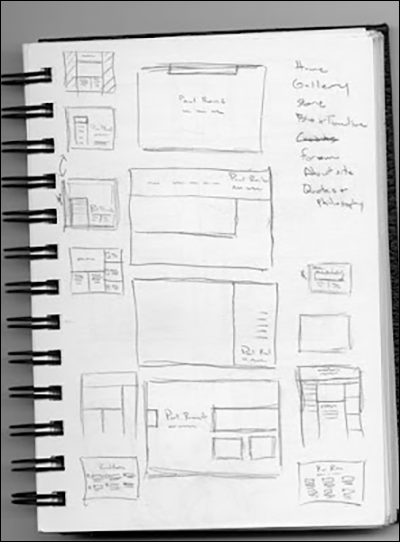
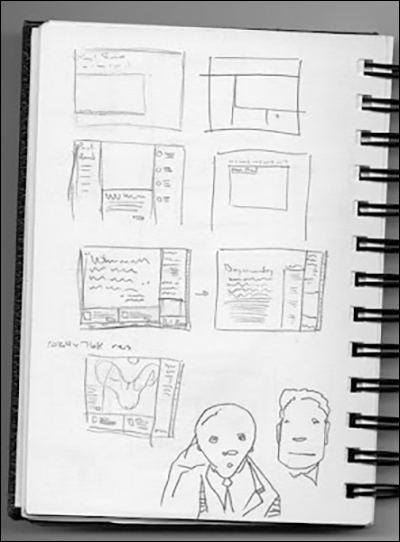
Before the initial site launch, I was working on the design in my spare time on and off for about a year and a half. I followed a typical design process: start with some thumbnails (images below), get an idea, put something in the computer, build it, tweak it, and launch it. I was never truly satisfied until I settled on the current design, which came to fruition in late 2007. I worked with a developer friend who helped set up the framework for the site, then I took over and tweaked the design myself as I saw fit. The bulk of the project has been gathering, scanning, photographing, retyping and otherwise inputting all the work and texts.


What is the most rewarding part of the project?

Every part is rewarding, but particularly hearing first-hand stories from people who’ve worked with Mr. Rand and finding rarely seen or difficult to obtain pieces.

Was there a part of the project that was particularly trying and how did you deal with it?

The most trying part was convincing myself to actually do it. I mean, how does someone of my minuscule design stature take on the godfather of American graphic design? I had to convince myself this was a worthwhile thing to do and get over the fact that I might get in trouble for it. Thankfully everyone has been very supportive.

What is your advice to people who aspire to do a site dedicated to a particular designer or design group?

Reach out to people who have the knowledge. You can’t do it all by yourself, so it’s OK to ask for help. Be nice, courteous and respectful of people’s time and energy when they share things with you. Cover your ass and get permission from the proper authorities. Take your time to understand your subject and create your project with love.

Any future plans for Paul-Rand.com that you want to share?

Keep hunting, keep gathering. I’d like to plan a trip to several universities to look through their archives, and also finally visit Mrs. Rand in person at her Connecticut home. For the site, I don’t have too many new plans at the moment—possibly set up a forum of some sort for informal design discussion. Otherwise, I’ll be on the look out for any Rand items floating out there. If anyone has anything they’d like to share for the site, please send it my way and I’d be thrilled to add it.

• • •

Images courtesy of Daniel Lewandowski.

• • •

Related: Design Shrines OnlineRelearning from Paul Rand

• • •

Read more from Design Feast Series of Interviews with people who love making things.


Please consider supporting Design Feast

Read this full interview and more by supporting Design Feast on Patreon. If you’re able to, please become a Patron of Design Feast today from $1 and up—it only takes a minute. Your monthly contribution will give you full access to this interview and those upcoming with extraordinary creators and their perspectives. Stay both informed and inspired.


What will stay free to completely explore at Design Feast are the 346 insightful interviews with an incredible range of Designers, Bloggers, Makers and realizers of Side Projects.